If the world is to feed its growing population, agricultural output needs to double by 2050, and this must be achieved sustainably. This is the challenge being addressed by RootEd, a €2.7 million Horizon Europe-funded project aimed at increasing crop yields and reducing greenhouse gas emissions.
RootEd – short for root education – will contribute to what UCD-based Project Coordinator Dr Saoirse Tracy describes as the ‘second green revolution’ which she says is necessary to achieve the massive increase in agricultural productivity required in the coming decades.

Saoirse Tracy, Assistant Professor in Applied Plant Biology in the School of Agriculture and Food Science. Image. ROOTED project
The answer is in the roots
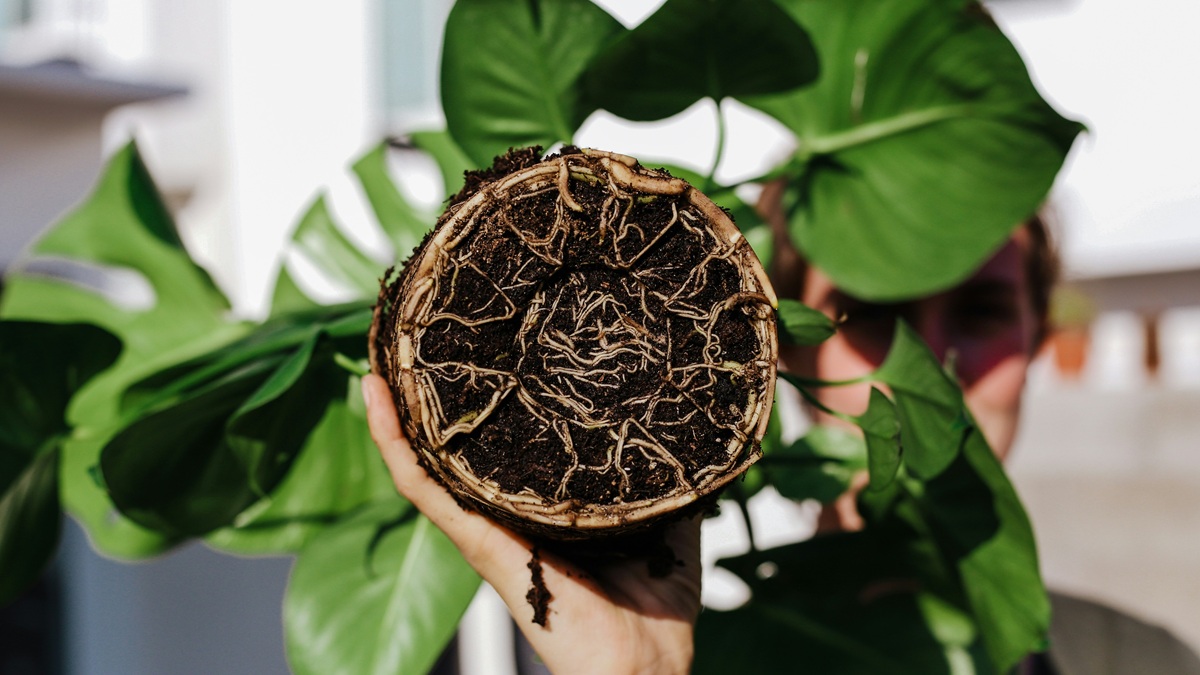
The first green revolution occurred in the 1950s when new varieties of crops were introduced to deliver much higher yields than their predecessors, Tracy explains. This came at a cost, however. “Those newer plants have to be pampered with fertilisers and other products,” she notes. “But with the rising cost of fertiliser and tighter regulations you can’t do that anymore. We need to look at new ways to make plants more productive on the same land. We need to look at their ability to grab nutrients and water from the soil, and the answer lies in the roots. A deeper understanding of the interactions between soils and plants and where they take up water and nutrients may support sustainable intensification of agricultural production.”
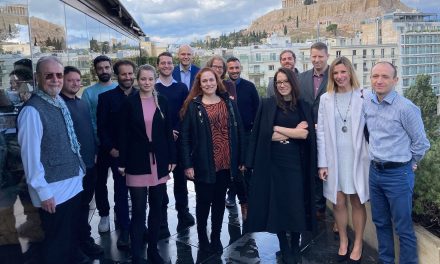
The 15-member pan-European consortium assembled by Tracy connects experts working on crop phenotypes with soil microbiologists to develop solutions which will contribute to more productive and sustainable agricultural systems. The research is being carried out by 10 Doctoral Candidates based in different European countries and this fulfils the other aim of the project which is to train the next generation of interdisciplinary plant and soil scientists.
Exploring the hidden half of agriculture
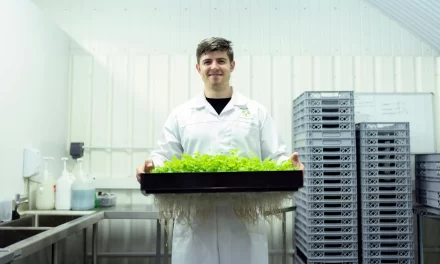
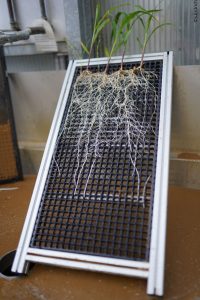
Plant phenotyping involves the measurement of plants, their height, length, diameter and so on, and how they interact with their environment, Tracy explains. “A lot of work has been done on the top half of the plant,” she adds. “But we are not really there yet with soil or roots. This is the hidden half of agriculture. You can’t just dig it up. It’s not an easy win. If someone could invent a machine to see plant roots in the field and how they are interacting with soil and if fertiliser is getting to them, they would be a millionaire very quickly.”
As a simple example she points to the application of surface fertiliser. This depends on rainfall to carry it into the soil. “In Ireland, average rainfall during a year may be quite consistent but we are experiencing more dry periods and periods of very heavy rainfall.” How efficiently the root system is able to grab available nutrients is therefore critically important.
Tracy’s involvement in the area dates back to her PhD at the University of Nottingham in 2008 when she used X-ray Computed Tomography (CT) to look at plant roots in the soil. That research led to her developing a network of contacts involved in root and soil science across Europe.
 Enterprise Ireland support
Tracy initially put forward a funding proposal in 2020 but was unsuccessful on that occasion. “I got really good feedback though and decided to go back with a new proposal,” she says. The proposal was approved in 2022 with work commencing in January 2023.
Funding of over €6,000 from Enterprise Ireland supported her while she was writing the proposal and also helped to finance the cost of an external consultancy, to guide her through the process. “Yvonne Halpin, the Irish National Contact Point for the Horizon Europe Marie Skłodowska-Curie Actions (MSCA) helped me during the process as well,” she adds.
The first year of the four-year project was spent on recruitment and other tasks. “We employed a research manager and put together the consortium agreement. We then had to recruit the Doctoral Candidates. “Most of the PhD students started work in September 2023 but because of visa issues some didn’t start until early in 2024.”
Research and training have continued apace since then with students visiting various consortium members for training in different aspects of the project including plant phenotyping and image analysis as well as in softer skills like leadership and communications.
Training the plant scientists of the future
The soil and plant scientists of the future will require a broad range of skills, Tracy points out. “They will need expertise in roots and soils, as well as digital skills. Our students spend some time out of their host institutions in other institutions and training with industry partners. This gives them an understanding of different lab cultures and the use of different equipment, making them job ready when they finish their PhDs.”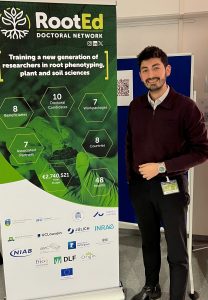
The research is primarily aimed at gaining a better understanding of how plant roots grow and interact with soil. “We are looking at the physical aspects of soil and its biology. We are applying AI to separate roots from soil in images. The roots are grey tubes in a grey matrix, and we are looking at using AI to figure out which is which by using contrast and shape. We are also looking at agricultural systems; for example, exploring how wheat roots interact with blackgrass weeds. We are looking at how to get plants to perform well. We might look back to older pre-1950s varieties of wheat and barley which had root systems twice the mass of existing varieties. By bringing in wild or older varieties we could allow the plant to put more roots down and take in more nutrients and water.”
A number of research papers are currently in draft form and Tracy expects them to be submitted for publication in the near future.
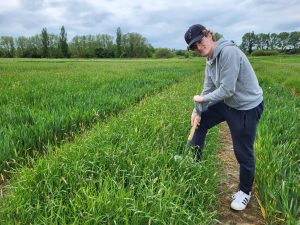 From a personal perspective, she says she has learned a lot about how to coordinate a project through participation in Horizon Europe.
Looking at the wider benefits, Tracy says the research could lead to the development of new higher yielding plant varieties resilient to waterlogging or drought. “Even at a basic level we will be able to give farmers information they don’t have yet on how the roots of their crops are interacting with the soil. That will help with decision making. It might allow them to use less nitrogen and manage soil in a different way to increase crop yield, for example. This offers both financial and sustainability benefits.”
If you are interested in finding out more about the Horizon Europe programme contact horizonsupport@enterprise-ireland.com for further information or go to www.horizoneurope.ie