
Ireland is not the only European country facing a severe shortage of affordable housing. While the causes may differ, the problem is shared across almost every EU Member State. The Horizon Europe-funded EqualHouse (Housing Inequality to Sustainable, Inclusive and Affordable Housing Solutions) project seeks to provide robust, evidence-based guidance to support and empower policymakers and other stakeholders in the development of affordable, inclusive and sustainable housing solutions.
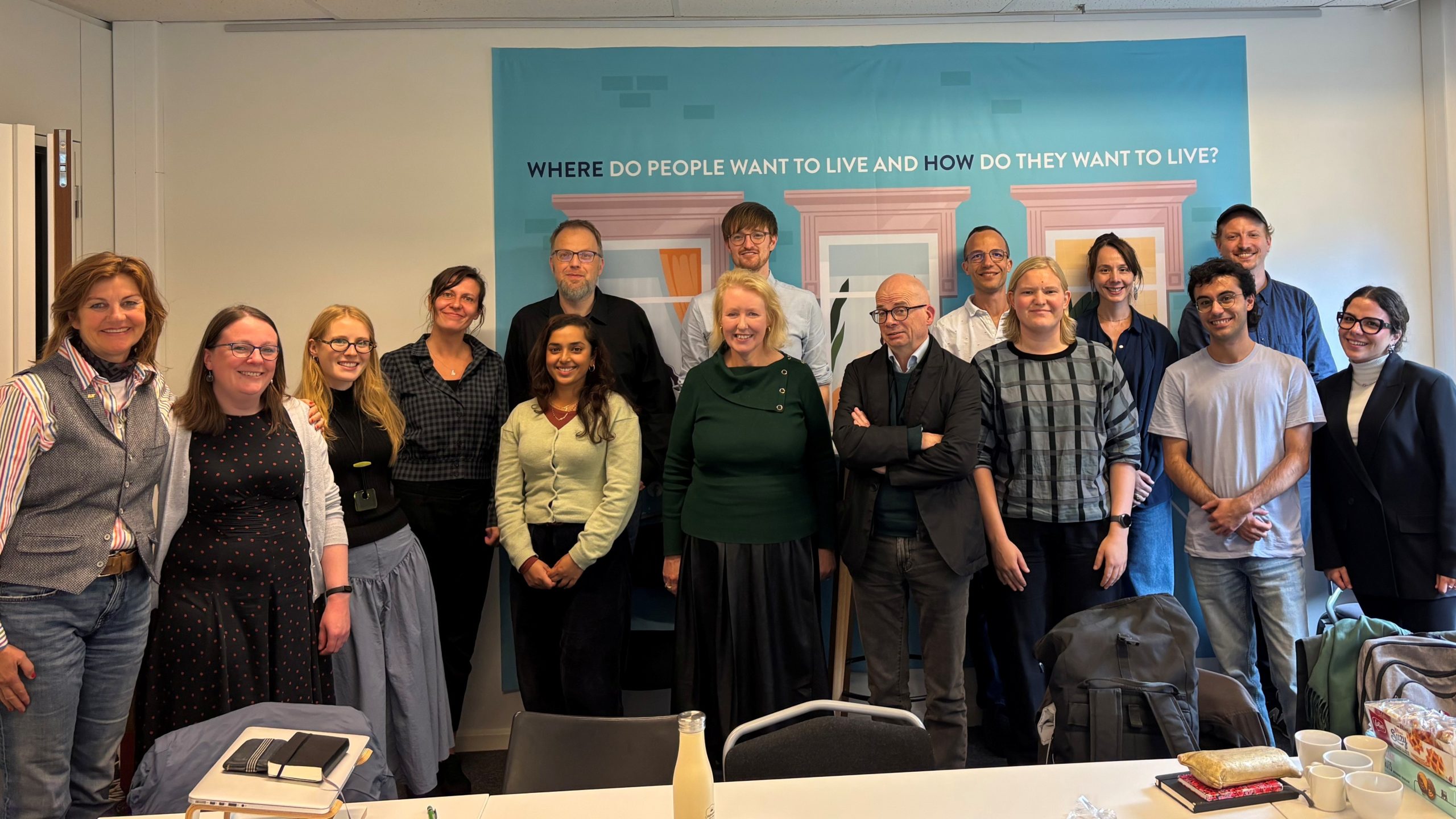
Led by University College Dublin (UCD), the EqualHouse consortium brings together twelve partner organisations including academics from a variety of European countries and disciplinary backgrounds, housing policymakers, and affordable housing and homeless service provider representatives to achieve its objectives.
This unique trans-disciplinary and pan-European approach to housing inequalities and policies research has also involved the creation of a pan-European interactive network of stakeholders known as the European Community for Housing Equality (ECHE).
Housing: a source of wealth transfer and inequality
Members of the EqualHouse consortium
Project Principal Investigator Professor Michelle Norris, who is also Director of the UCD Geary Institute for Public Policy, explains that while housing has become an increasing focus for investment and wealth generation and transmission in recent decades, it has also become a significant cause of inequality.
“Access to decent and affordable housing is a basic human need as well as a human right recognised in the Universal Declaration of Human Rights and the European Social Charter, but these needs and rights are not always fulfilled in Europe,” she says.
The project is a continuation of work previously carried out by Prof Norris and other members of the consortium. “A group of us had worked on the UN Housing2030 project which produced playbooks and guides to improve housing affordability in Europe,” she explains. “We wanted to further develop the work. The Horizon Europe call came and that was an opportunity to conduct more in-depth research. EqualHouse is more narrowly focused on EU Member States and the UK. All the original members of Housing2030 along with other colleagues and research institutions are involved. Access to Horizon Europe funding has allowed us to build on the successful Housing2030 collaboration.”
With grant assistance from Enterprise Ireland to support the preparation of the application, the consortium secured €3.4 million in funding from Horizon Europe under the Cluster 2 Culture, Creativity and Inclusive Society programme area.
Investigating the causes and consequences of housing inequalities
The four-year project commenced in 2024 and is helping to shine a light on the causes and consequences of housing inequalities and the challenges that people face in accessing affordable, secure and good quality housing, Prof Norris continues.
The project’s different work packages help raise awareness of the scale of housing inequality across Europe and how it affects individuals and communities as well as contributing to the development of new policy solutions and practices to address it.
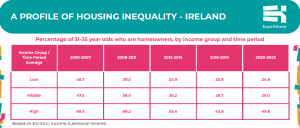
Researcher’s comment: “In Ireland, ‘income’ is a far better predictor of housing precariousness than age.”
One of those work packages has already produced a profile of housing inequality in Europe. It utilised existing pan-European surveys and other data sources to provide a comprehensive overview of both the scale of housing inequality in Europe and its form in terms of its affordability, accessibility, quality and other housing-related inequalities such as energy poverty. Also addressed are the relationships between Europe’s emerging housing crisis and the rise in extreme forms of housing exclusion such as homelessness.
Prof Norris’s work package is looking at finance for housing including aspects like rent regulation and taxation. “We are looking at the scope of interventions governments can use and how they can be applied in different countries,” she says. “We are also looking at how they can be transferred from one country to another and the potential impact of European Central Bank (ECB) regulations. Another work package is looking at energy efficiency and poverty, and we have another on migration.”
Addressing social housing deficits
Social housing is another area of focus. One aspect being addressed is how arrangements used in Western Europe might be adopted and adapted by the social housing sector in Eastern Europe.
She points out that almost all of the former East Bloc states sold off their social housing stock in the early 1990s. “There is a whole series of problems associated with that,” she explains. “There is a lot of ageing, low-quality housing occupied by people on low incomes without the capacity to upgrade or even maintain it. At the same time, there is very little new housing output in those countries and very little rental property either. In Romania, for example, the home ownership rate is 97% and it is very difficult for people to leave home because of the housing shortage. These are some of the issues we are looking at. We are looking at solutions being deployed to address them including some really innovative practices in Czechia.
“For example, the Czech government is establishing a national ‘revolving fund’ for social housing which is influenced by a similar model that has been operating successfully in Denmark for several decades. This will provide low-cost loans for social house building which will be repaid by tenants’ rents and this will fund additional lending.”
The regulatory environment comes into play in this area as well. “There are national rules that limit spending on social housing in certain countries,” she notes. “We are looking at those at a macro level. But how do you overcome the structural problem? Public investment in social housing delivery targeted at low-income households has been inadequate for 30 years. The European Investment Bank (EIB) has got much more involved in that area and is now the main funder of social housing in the former East Bloc. But the social housing organisations aren’t there to provide it. How do you build those organisations from scratch?”
In addition, a significant report has been produced on the scale and nature of housing inequalities related to income. “We are almost finished an analysis of the relationship between wealth inequality and housing inequality,” Norris adds. “This research can be challenging with so much data to collect across so many countries and so many different surveys. We need to know about differences across the EU in terms of what is included in the surveys and what is not. Everyone thinks their country is unique, but they’re not. Of course, there are differences but there are lots of parallels between countries.”
Practical solutions for policymakers to implement
 The ultimate aim is to identify more effective policy responses and practical solutions to housing inequality. This is enabled through the establishment of the European Community for Housing Inequality. Two members of the consortium also represent housing policy implementers – FEANTSA represents non-profit sector providers of accommodation for homeless people in Europe and Housing Europe represents social housing providers.
“We have done a lot in the last two years,” says Norris. “We are clarifying the scale and nature of the problem across the EU and the UK. This is the first time this has been done. We are very focused on practical solutions and communicating them effectively to policymakers.”
Ultimately, the EqualHouse project aims to provide a comprehensive overview of the scale, form and socio-economic and spatial distribution of housing inequalities across Europe.
Other aims include to:
- Examine the most significant transnational policy, regulatory and financial influences on housing inequalities and identify how they can be addressed.
- Investigate the role of housing and land use policies, subsidies, regulations and personal allowances in producing and reducing housing unaffordability and inaccessibility.
- Identify innovative solutions to homelessness and acute housing inequalities focusing on the needs of refugees and migrants.
- Explore the potential of socially innovative housing models, including measures to supply affordable land for housing, to mitigate housing inequalities
- Imagine more effective solutions to address housing inequalities in a more sustainable, affordable and inclusive way and promote their use across European cities, regions and countries.
Find out more about EqualHouse here.
If you are interesting in learning more about the Horizon Europe programme, contact horizonsupport@enterprise-ireland.com or go to www.horizoneurope.ie