
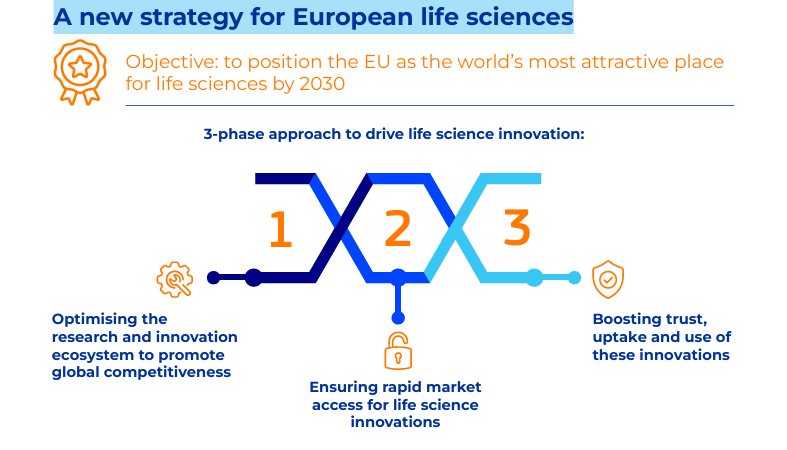
In July 2025 the European Commission published its Strategy for European Life Sciences, setting out an ambition to position Europe as a global leader in life sciences. The Strategy aims to optimise the research and innovation system, accelerate the uptake of innovations, and create the conditions for companies and researchers to translate scientific discoveries into societal and economic impact. The Strategy forms part of the Commission’s wider competitiveness agenda and was identified as a priority in both President von der Leyen’s Political Guidelines 2024-2029 and the Competitiveness Compass.
It responds to persistent challenges facing Europe, including increasing global competition, fragmented research and innovation ecosystems, difficulties in scaling innovation, and complex regulatory pathways. Backed by more than €10 billion annually from the current EU budget, the Strategy sets out a coordinated approach across the life sciences value chain through a series of flagship and implementation actions spanning health, biotechnology, agriculture, environment, data, and advanced technologies.
Of the 27 implementation actions, 21 are particularly relevant to health-related research and innovation. Under Horizon Europe’s Health Cluster, approximately €793 million has been mobilised in 2026-2027 to support implementation.
Progress after one year
One year on, the Strategy enjoys broad support and has helped align policy discussions across sectors, while focusing attention on key challenges in research, regulation, funding, and health data.
Examples of ongoing implementation activities include:
- Climate Change and Health: Implementation of the Strategic Research and Innovation Agenda on Climate Change and Health and development of a platform for international funder collaboration. Three related Horizon Europe topics launched in 2026 attracted approximately 160 proposals, demonstrating strong interest.
- Health and Life Science Innovation: Horizon Europe investments in 2026 in areas such as regenerative medicine, advanced therapies, public procurement for innovation, and building public trust and outreach in the life sciences.
- One Health: Discussion on the development of practical guidance to support One Health approaches in research and innovation.
- Biotech Act: The Biotech Act, published in December 2025, is expected to become a key legislative tool for implementing elements of the Strategy, with a focus on innovation ecosystems, artificial intelligence and the effective use of health and research data.
- Clinical Research: Discussions on a non-legislative Clinical Research Investment Plan to strengthen multinational clinical research and improve research infrastructure coordination.
While many actions remain at an early stage, the Strategy is already influencing the direction of Horizon Europe investments and policy development.
 What does this mean for Horizon Europe applicants?
The Strategy’s priorities are becoming increasingly visible across Horizon Europe work programmes and related policy initiatives. Areas such as One Health, climate change and health, advanced therapies, health data, artificial intelligence and innovation uptake are likely to remain prominent in future funding opportunities.
Ireland’s ongoing development of a National Life Sciences Strategy also presents opportunities to align national priorities with European initiatives and strengthen participation in collaborative programmes.
Examples of topics in the draft 2027 Health Cluster Work Programme that align with the strategy include:
- HORIZON-NATURE-2027-03-01: Advancing interdisciplinary, data-driven research at the biodiversity-health interface under a One Health approach.
- HORIZON-HLTH-2027-01-ENVHLTH-02: Integrating climate-related exposures into the human exposome and characterising its changes in response to climate change
- HORIZON-HLTH-2027-01-ENVHLTH-MISSCLIMA-03: Tools and technologies to support health adaptation to climate change (a pre-commercial procurement intervention)
- HORIZON-HLTH-2027-02-DISEASE-14-two-stage: Clinical trials for advancing innovative interventions for neurodegenerative diseases
- HORIZON-HLTH-2027-03-TOOL-02: Advancing bio-printing of living cells for regenerative medicine
A cross-Commission Life Sciences Coordination Group is overseeing implementation and policy coherence. Stakeholders should also watch for an EU Life Sciences conference being discussed for late 2026 / early 2027, which should provide updates on progress, priorities and opportunities.
For further information contact PClarke@hrb.ie and to find out more about Horizon Europe, go to https://horizoneurope.ie/