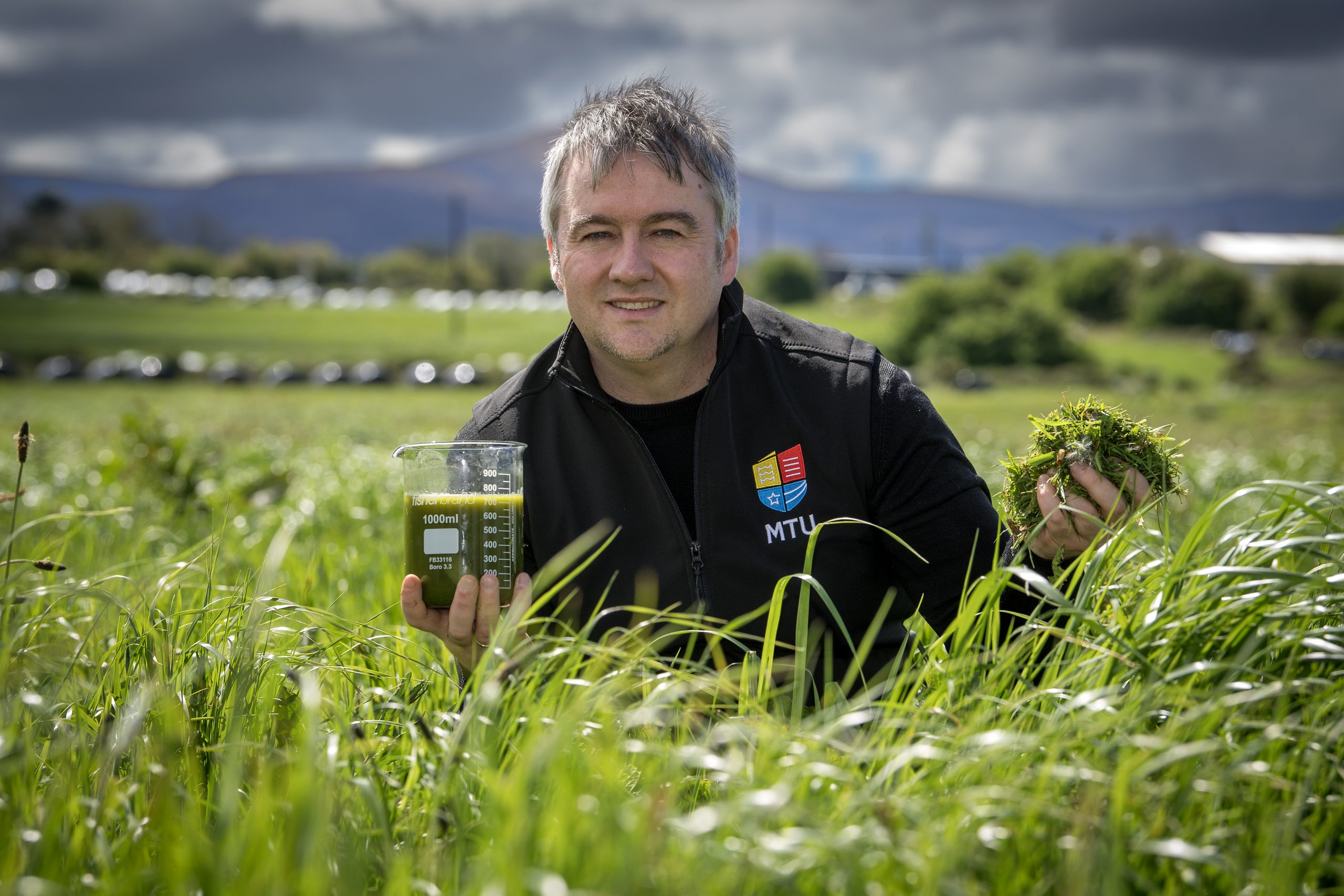
Project Coordinator James Gaffey pictured above
The Horizon Europe-funded Rural BioReFarmeries research project has the potential to boost rural economies and bioeconomy at the same time as delivering significant environmental benefits by optimising Ireland’s most abundant natural resource, grassland.
Over 90% of Ireland’s agricultural land is used for growing grass which is primarily utilised for feeding livestock. The Rural BioReFarmeries project aims to extract additional value from grass through the production of bio-based products including protein ingredients for human consumption, flavours for the food and beverage sector, anti-microbial additives with health and sustainability benefits, packaging materials, and fertiliser, while still providing the animal feed required by farmers. Alongside all that, the residue from the production process can be used to produce biogas to generate renewable power.
Project kick off meeting in Cork with the CBE JU project officer and consortium members
Led by a team at Munster Technological University (MTU), the Rural BioReFarmeries consortium brings together 19 academic and industry partners from eight EU member states including Aarhus University, Carbery Group, University College Dublin, Barryroe Cooperative, Wageningen University, Carhue Piggeries, MTU Australo Alpha Lab, NuaFund, ODOS, University of Galway and Trinity College Dublin.
At its simplest, grass biorefining activity can be broken down into two stages. The first occurs on farm or nearby and involves pressing newly harvested grass to separate it into its fibre and liquid components. The fibre is turned into feed cakes for cattle, again on or close to the farm. In the second stage the juice, which is rich in proteins, sugars and minerals, is transported to a centralised biorefining facility where the higher value biobased outputs are produced.
No compromise on feed quality
Despite the extraction of the proteins and other nutrients, the feed cakes still make good quality forage for cattle, explains Project Coordinator James Gaffey. “Often in the cattle diet, there is an oversupply of protein from the grass. We have shown that even though the feed cake is lower in protein, the protein that remains is more efficiently used and milk production from cows fed on it is at least on a par with a traditional grass and silage diet.”
The juice from the grass can be refined and processed to manufacture a wide variety of valuable products from pig feed right through to protein supplements for human consumption and anti-microbial additives for food and drink.
Positive environmental impact
“We have had a lot of success with the juice portion,” says Gaffey. “About 40 to 50 per cent of the original grass protein is in the juice. We have already used it for pigfeed prior to this project. Pig farmers are highly dependent on soya bean for feed at the moment. We can reduce that dependence and displace those soya bean imports. This will have a positive environmental impact as well.”
That positive environmental impact is further enhanced through the production of biogas from the grass biorefinery residues which can be used to generate the power required to run the biorefineries.
New income streams for the rural economy through bioeconomy development
The additional higher value bio-based products can help provide new income streams for farmers and other players in the rural economy including dairy co-ops and other enterprises. “We could compare this to the dairy industry which has moved from solely cheese and butter production to a point where the waste streams from those products are now some of the core value streams of the business in terms of whey proteins, ingredients and so on. We are taking a similar approach with grass.”
A decentralised production model is being evaluated in the project whereby farmers would harvest the grass with initial biorefining activity taking place on farm or nearby and the outputs being transferred to other sites for further product development, Gaffey notes. The existing farmer co-op network in Ireland could be utilised to support this, ensuring that farmers are fully incorporated into the business model and economic benefits are retained in the region. Gaffey points to the strong participation and collaboration of Carbery Group, Barryroe Cooperative and Carhue Piggeries as key co-op and agri partners on the grass biorefinery initiative.
Gaffey has been involved in research in the area since 2017 and had already been working with a number of the companies and higher education institutions which subsequently became involved in the Rural BioReFarmeries project. Having brought that work to a certain point, it was decided to apply for funding under the Horizon Europe Circular Bio-Based Europe Joint Undertaking (CBE JU) Programme in September 2023.
Industry partnerships enhance commercial potential
According to Gaffey, support from Horizon Europe has allowed the Irish partners to engage with other experts in the field from across Europe. “We knew that a lot of great work was happening in other countries, and we wanted to bring in new overseas partners to bring in new thinking and new possibilities. It has also allowed us to collaborate with industry partners, who can bring real world and market experience, which can help to validate the processes and products we are developing, which in turn can help us to optimise our approach and increase the opportunities for commercial uptake. Another attractive aspect of the funding is that it promotes innovation and has allowed us to build and scale new technologies and products.”
The initial application for funding was submitted in September 2023 with €7.35 million subsequently awarded to the €8.7 million project. “We kicked off the four-year project in December 2024 with a launch event in Cork,” he adds.
The project team received an Enterprise Ireland Coordinator Support Grant to assist with the development of the funding application. The application was also discussed with the Horizon Europe National Contact Points (NCPs) for Cluster 6 and Circular Biobased Europe Joint Undertaking based in Enterprise Ireland and the Department of Agriculture, Food and the Marine who both provided feedback on the proposed approach. “Over the years, we have found the NCPs to be extremely approachable and willing to support with practical advice and introductions,” says Gaffey.
Irish partners in the Rural BioReFarmeries Consortium at Munster Technological University with the project officer and representatives from the Department of Agriculture, Food and the Marine
Overcoming challenges
While the development of grass biorefineries is still at an early stage across different EU countries, a number of challenges in the green biorefinery model have been identified through previous projects and initiatives. These include high logistics and transportation requirements in the grass biomass supply chain, a seasonal supply chain with grass not growing all year round, and a relatively low value product portfolio in current green biorefinery systems.
To address these challenges, the project team is working on a smart biomass supply chain system to address the logistics issue and is developing a flexible feedstock system which may include crops like sugar beet leaves to ensure year-round process viability. The low value issue is being dealt with head on through the development of a suite of much higher value products which can complement the existing portfolio.
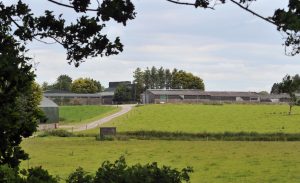
Farm Zero C
At this stage, work is currently being carried out in the lab at bench scale. That will shortly move to pilot scale facilities. Next year will see the development of demonstration scale biorefinery facilities in Ireland, Denmark and the Netherlands which will verify the environmental and economic viability and technical suitability of small-scale decentralised green biorefinery models. The Irish Demonstration site, which is located at Farm Zero C in Cork, will also leverage a €3 million investment by the Department of Agriculture, Food and the Marine in a co-located AD and Green Biorefinery facility.
The demonstrator sites will focus on testing different biorefinery value chain approaches, including different feedstock mixtures, scales, logistical plans, biorefinery processes and products, collecting data from both farm and biorefinery operations and processes.
Realising the benefits
Over the coming years, work will continue on the development of an integrated biorefinery model. If the model is successful, the next step will be to see it adopted at commercial level by stakeholders. “That is where the biggest impact can be made,” says Gaffey. “If even a small amount of our grasslands were devoted to this activity, it will make a large impact in areas such as greater food and feed resilience, improved economic competitiveness, reduced environmental emissions and an increase in local enterprise activity and jobs.”
If you would like more information or advice about accessing Horizon Europe support, please contact horizonsupport@enterprise-ireland.com or visit HorizonEurope.ie.