An Irish-led Horizon Europe funded project is putting new tools in the hands of European law enforcement agencies to help them in their battle against disinformation campaigns linked to criminal activity.
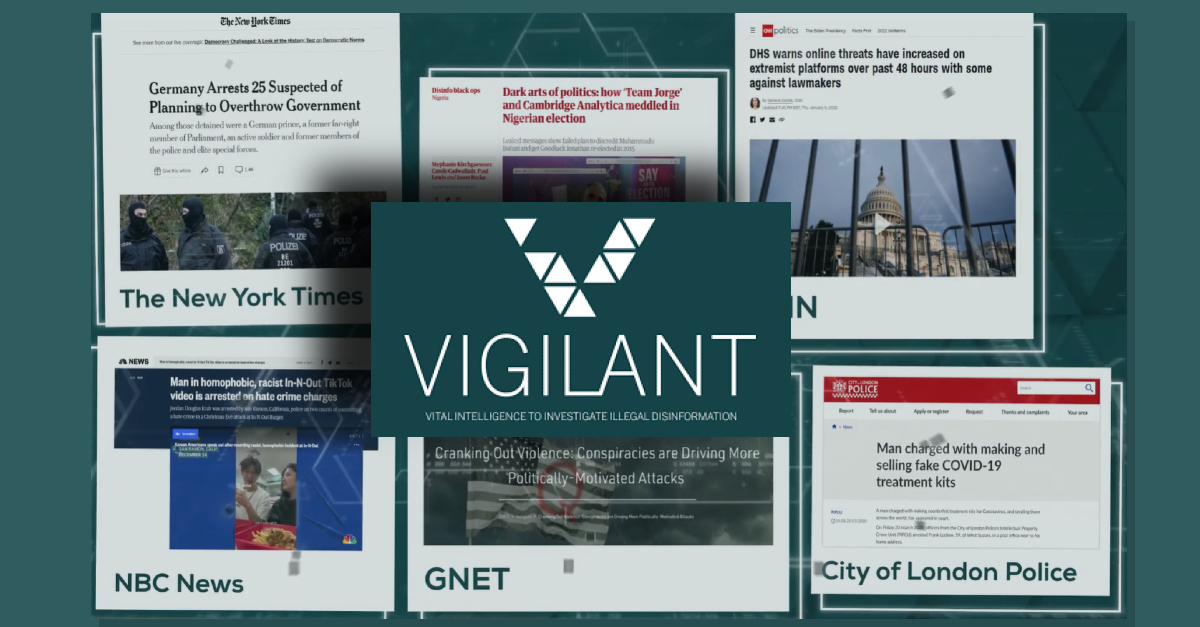
The use of disinformation campaigns by criminal actors is nothing new but its scale and level of sophistication has grown at a near exponential rate in recent years. The €4 million VIGILANT (Vital IntelliGence to Investigate ILlegAl DisiNformaTion) project will create a platform containing over 30 different tools which help to detect, analyse and tackle disinformation in multiple formats, from multiple channels, and in multiple languages.
Solving a problem that ignores borders
The project also includes first-of-its-kind disinformation response and investigation training for police officers. In addition, the project team is engaged in the establishment of a specialist European network for law enforcement officers to share their experiences and knowledge of disinformation promoting a unified European approach to a problem that ignores borders.
Led by researchers at the ADAPT Research Ireland Centre for AI-Driven Digital Content Technology, the 17-strong VIGILANT consortium comprises scientists, universities, think tanks, government research centres, and law enforcement authorities from 11 European countries. The consortium also works with a dozen other European law enforcement agencies.

Brendan Spillane, Project Executive Manager
The project’s origins can be traced back to Project Executive Officer Brendan Spillane’s long held interest in the topic. “I always had an interest in news and information and why humans accept or reject information and why they believe it’s credible or not,” he explains. “I did my PhD in the area of the credibility of news. It’s an easy step from there to disinformation. In about April 2021 I started looking at putting together a proposal for a Horizon Europe project. In some ways I didn’t know what I was getting involved in. I was a bit naïve, I suppose, but the support from ADAPT and Enterprise Ireland was of enormous help.”
The ADAPT Research Development Team played a major role in supporting the proposal preparation, he adds. “ADAPT has eight universities and higher education institutions as partners and has deep expertise in large-scale funding programmes like this. Claire Whelan, the International Engagement Manager at the ADAPT Research Centre in Trinity College Dublin (TCD), did a huge amount of work to support us and gave us a lot of very valuable advice. We also worked with the University of Sheffield to build the rest of the consortium across Europe.”
At a very early stage, Spillane applied for and received an Enterprise Ireland Horizon Europe Coordinator Support Grant. “This provides funding of up to €12,500 to Irish researchers coordinating Horizon Europe projects,” he explains. “The aim is to support increased participation by Irish researchers in the Horizon Europe programme. If they are successful in their proposals, that will bring in many multiples of that initial funding into the Irish research system. In this case, €820,000 came back to TCD and University College Dublin (UCD) out of the overall €4 million funding for the project.”
That initial Enterprise Ireland support played a very important role. “It allowed us to do some simple things like get graphic designers in to improve the visual presentation of the application. We were also able to bring in Irish consultancy firm Pintail to carry out an external review of the proposal.”
The value of non-financial support
The single most valuable aspect of the support from Enterprise Ireland was non-financial, Spillane adds. “The conversations we had with Dr Michael Murphy, the National Contact Point for Horizon Europe Cluster 3, were worth far more than money. He was able to tell us about things that we would never have been able figure out or known without years of experience. Among other things, he was able to point us in the right direction and introduce us to the right people.”
The project is funded under Horizon Europe Cluster 3 – Civil Security for Society. “This covers everything from flood defences to policing and border control, to emergency response to natural disasters and major incidents,” he explains.
Enhanced capability and improved effectiveness
The project proposal was submitted in November 2021 and approved for funding in April 2022. “The project kicked off in November 2022 and will run until October 31 this year,” says Spillane. “The main objective is to build technical tools to assist law enforcement agencies to detect, analyse and address disinformation campaigns that lead to criminal activity.”
These campaigns can involve incitement to hatred against religious or other groups in society, the promotion or sale of fake medical cures, financial scams targeting vulnerable members of the population, and much else besides.
“The vast majority of law enforcement agencies are very ill equipped to deal with the sort of disinformation campaigns being created and deployed today,” Spillane points out. “In many cases they are doing it by hand using Word documents or pen and paper. We are building a solution comprising over 30 separate tools for the detection, investigation, and forensic analysis of disinformation contained in a single platform. This will provide law enforcement agencies with the capability to become much more effective and efficient in their approach to disinformation.”
The platform can analyse in seconds huge volumes of disinformation content that it would previously have taken days and weeks when done manually.
Designed to meet the needs of end users
VIGILANT is an Innovation Action (IA) project with a focus on producing working tools and solutions that can be put to work straight away by law enforcement agencies. “We are not looking for the next cutting-edge proof of concept solution,” Spillane says. “We ask if a tool works and if it can be deployed successfully. There is no perfect in our world. Good enough is not good enough either; we want very good. We have put a lot of exciting stuff together in one ecosystem on the platform and ensured that the tools work together. The platform has been designed with police procedures in mind. We fit in with them rather than asking them to fit us. All the countries involved have different policing models and the platform fits in with all of them.”
As the project draws to a close, Spillane believes it has delivered on its objectives. “We are in a pretty good place. We have developed the platform and the training and are establishing the network. The platform is only for law enforcement agencies, and it will be available in the first instance to the four police authorities involved in the project. After that, the aim is to make it available to as many as possible law enforcement agencies across Europe as possible.”
Openness to change
There have been some very valuable learnings along the way as well. “We started the proposal in 2021 for what the world looked like then and we are now in mid-2025. There are some parts of the proposal that we are not doing because they are no longer relevant and some of the things we are doing were not in the original proposal. Not everything is done the way you had imagined it. But that’s OK. Something you envisaged in 2021 may no longer be relevant and sometimes a partner comes up with a new and genuinely innovative way of doing something. There needs to be some flexibility, especially in an area like this which can change so rapidly.”
The benefits of being part of a large-scale research centre like ADAPT have been brought home very clearly. “The support from ADAPT and from TCD and UCD was very important to us. Multiple times on the journey we reached out to people for help and advice and found them always willing to help. Establishing a network of people working in the area and having contacts across Europe expert in different aspects like AI, video analysis and so on was also critically important.”
New opportunities
Looking ahead, the VIGILANT project and participation in Horizon Europe will open doors to further projects for Spillane and his colleagues in Ireland. “We are already a partner in the ATHENA project which is aimed at protecting the democratic process by empowering the EU and its citizens to detect, analyse, and counter foreign information manipulation and interference (FIMI). We have also applied with partners for funding in other areas and are currently involved in a number of other consortiums.”
If you would like more information or advice about accessing Horizon Europe support, please contact horizonsupport@enterprise-ireland.com or visit HorizonEurope.ie