Novelties in the 2027 Work Programme
 Late July saw the publication of the 2027 Work Programme which saw various changes, mostly long trailed. The most significant change for this year will be the change to the eligibility periods:
- Starting Grants – 0-10 years post-PhD
- Consolidator Grants – 5-15 years post-PhD
We don’t yet know the likely ramifications for this change, and it is probable that the effects on this year’s calls will be particularly pronounced. However, we will keep monitoring and let you know.
A new rule has been put in place meaning that it is not possible to have two applications under assessment at the same time, even if the applications are to different years’ work programmes. This means that if, for example, an application were submitted to ERC+ 2026 (deadline just passed) then it will not be possible to apply to the first Starting Grant deadline (October). We don’t anticipate that this will effect a large number of candidates but obviously for any who are affected it will be important to plan properly.
Some additional restrictions apply:
- Former and current Starting and Consolidator Grant holders may not apply for the same type of grant in 2027
- Advanced and ERC Plus 2026 grant applicants may not apply for a Synergy Grant 2027
- Advanced Grant 2027 panel members may not apply for an ERC Plus Grant 2027
- Should one Principal Investigator of a Synergy Grant group be declared ineligible, the whole group will be declared ineligible for a Synergy Grant 2027
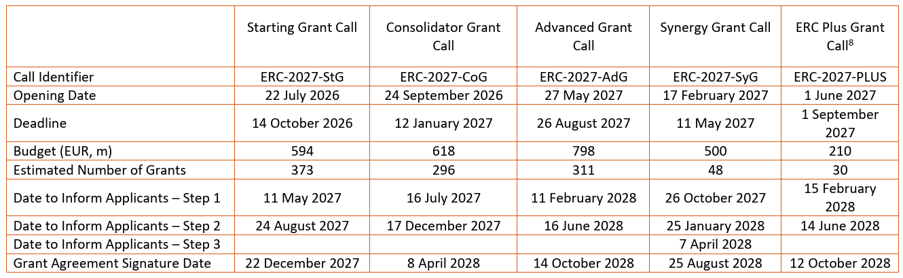
The timetable for the 2027 calls is as follows:
ERC Advanced Grant awardees
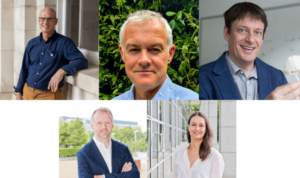 In July we were delighted to hear of the success of five applicants to the Advanced Grant 2025 scheme. The five new awardees are Professor Porscha Fermanis, University College Dublin (UCD); Professor Richard Layte, Trinity College Dublin (TCD); Associate Professor Rory Johnson, UCD; Professor Anthony O’Mullane, UCD; and Professor Rhodri Cusack, TCD. Their research spans the Social Sciences and Humanities, Life Sciences, and Physical Sciences and Engineering, reflecting the breadth, quality and international competitiveness of Ireland-based research.
Details of the awards are:
| Applicant | Institution | Panel | Project |
| Professor Porscha Fermanis | UCD | SH5 | PanAsia – Anticolonialism, Pan-Asianism, and Periodical Culture in Southeast Asia, c. 1850–1920 |
| Professor Richard Layte | TCD | SH3 | The Foundations of Life Course Outcomes in Relationships and Social Connection |
| Associate Professor Rory Johnson | UCD | LS2 | Directed Evolution to Understand and Engineer Bioactive Long Noncoding RNAs |
| Professor Anthony O’Mullane | UCD | PE4 | Adaptive Liquid Metal Electrocatalytic Reaction Systems |
| Professor Rhodri Cusack | TCD | SH4 | Development of Visual Cognition in Infants and Machines |
Read more here – congratulations to all the awardees.
ERC Proof of Concept awardees
Congratulations as well to three recent winners of ERC Proof of Concept awards. These awards of €150k each will enable the commercialisation or implementation of results from existing ERC awards. Irish awardees announced in July include Trinity College Dublin’s Prof Matthew Campbell and Prof Valeria Nicolosi, and Prof Fergal O’Brien from RCSI University of Medicine and Health Sciences. Projects will focus on novel gene therapies for macular degeneration, transforming wood waste into sustainable electromagnetic interference shielding materials, and developing a digitally enabled electroconductive patient-specific stimulation implant for spinal cord injuries.
For further information contact patrick.lansley@researchireland.ie and to find out more about Horizon Europe, go to www.horizoneurope.ie