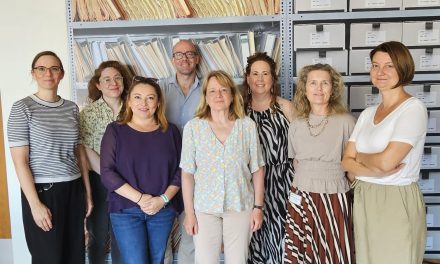

IEA’s Technology Collaboration Programme representatives gathered at IEA headquarters in Paris in June. (Photograph: IEA)
International research collaborations do not begin when a funding call is published. The strongest consortia are often built on relationships developed over time through shared technical work, international networks and a clear understanding of complementary expertise. For Irish energy researchers and companies, participation in the International Energy Agency’s Technology Collaboration Programmes (IEA TCPs) offers a structured way to build those foundations.
The IEA Technology Collaboration Programmes are international networks of researchers, businesses, policymakers and technical experts working together to advance energy technologies, systems and practices. Almost 40 TCPs operate under the IEA framework, with Ireland formally participating in 12 across areas including wind energy, bioenergy, buildings, district heating, energy efficiency and smart grids.
TCP activities are generally organised through focused research collaborations known as Tasks or Annexes. Participants contribute expertise, data and national case studies and work together to develop outputs such as technical reports, datasets, models, tools, methodologies and recommended practices. Through this work, Irish experts can collaborate directly with international peers addressing similar research and deployment challenges.
SEAI acts as Ireland’s national signatory to the IEA TCP Implementing Agreements and coordinates Ireland’s participation in the programmes. Through regular appointment calls, SEAI invites experts from eligible Ireland-based organisations to apply to represent Ireland in selected TCP Tasks and Annexes. SEAI covers the relevant participation fees and provides financial support for attendance at in-person project meetings. For a number of IEA Bioenergy Tasks, SEAI delivers this support in partnership with the Department of Agriculture, Food and the Marine (DAFM) and the Department of Transport.
Enhancing your Research Activities Through IEA TCP Participation
Irish representatives on TCPs flag multiple benefits to getting involved in these networks. These include:
- contributing to the development and deployment of energy technologies, processes and systems of international importance;
- exchanging information with leading research, industry and public-sector organisations;
- learning from and helping to shape emerging international practices, methods and standards;
- raising the profile of Irish expertise within specialist international networks; and
- building relationships and research capability for future transnational collaboration.

The final benefit is particularly relevant to potential applicants to Horizon Europe and other competitive research programmes. By working together on a sustained technical programme, participants can demonstrate their expertise, identify complementary capabilities, develop trust with potential partners and define research gaps that may subsequently form the basis of national or European funding proposals.
Recent Irish examples illustrate several ways in which TCP involvement has informed or complemented funded research activity:
- The SEAI-Funded project IDEA-IRL (Integrated Design of Floating Offshore Wind Arrays) is an effort to build on the work being undertaken Wind TCP Task 49, encompassing over 75 organizations from 12 countries, and apply it to an Irish context to address the pressing research requirements for Floating Wind.
- Professor David Styles of the University of Galway and Professor James Gaffey of Munster Technological University represent Ireland in IEA Bioenergy Task 45, which examines the climate and sustainability effects of bioenergy within the circular bioeconomy. Their participation provides a channel for exchanging approaches to sustainability assessment with international experts. The EPA-funded BIO-INSIGHT project builds on closely related research themes, including the evaluation of cascading bio-based value chains and biorefineries, and will also draw on outputs from the DAFM-funded Grass4Value project.
- University College Cork’s participation in two large EU-funded projects, Forward 2030 and WEDUSEA, focused on developing tidal and wave energy technology developments respectively, draws from work being undertaken by the participants from the university within several Ocean Energy Systems TCP tasks on environmental effects, technology modelling and validation, and common performance metrics.
How to get involved in an IEA Technology Collaboration Programmme
If you are interested in contributing to an IEA TCP and representing Ireland in an international network relevant to your area of expertise, the SEAI website provides information on Ireland’s current TCP participation and the Tasks and Annexes supported through the appointment process.
SEAI runs a regular appointment process that is open to experts working in public and private sector organisations based in Ireland. Our current participants are drawn from SMEs, large companies, universities and other research performing entities and semi-state bodies. For queries, or to join the mailing list for future appointment calls, contact iea@seai.ie.
For further information regarding Horizon Europe Cluster 5 activities contact Brendan.Cahill@seai.ie and to find out more about Horizon Europe go to www.horizoneurope.ie