
The adoption of circular economy principles has the potential to reduce costs and open up new markets for European businesses whilst also supporting the achievement of climate goals. The iCircular3 Digital Circular Economy Transition project is developing new guidelines and tools for the integration of circularity in industry.
Led by Dr Pezhman Ghadimi and Professor Nikolaos Papakostas based in the School of Mechanical and Materials Engineering, University College Dublin, the pan-European project consortium is focusing on the industrial robotics, outdoor power tools and electric vehicle (EV) sectors. Each of these innovative and highly complex industry sectors faces significant challenges in achieving circularity.
The €2.56 million (€2.2 million EU contribution plus €0.36 UKRI contribution) project supports the goals of the EU’s Circular Economy Action Plan (CEAP). Adopted in 2020, the CEAP is aimed at driving the transition from the linear ‘take-make-use-dispose’ economic model to a regenerative growth model where the value of products, materials and resources is maintained in the economy for as long as possible, and the generation of waste is minimised.
Developing future circular economy leaders
Funded by the Horizon Europe Marie Skłodowska-Curie Actions (MSCA) programme, iCircular3 aims to develop a cohort of future leaders in research, policy, and business through an innovative training programme focused on an interdisciplinary and intersectoral approach to the circular economy. In pursuit of that goal, iCircular3 will train nine researchers in the field of the circular economy and its digital transition.
These researchers are working on a number of projects aimed at improving the circularity of the three industry sectors from design through to product end of life.

Project Coordinator and UCD Assistant Professor Dr Pezhman Ghadimi
The project has its origins in 2019 when the CEAP was being developed. “We knew that the European Commission was developing new policies on the circular economy and that led us to thinking about what we could do in the space with some of the industry partners we were working with at the time,” explains Project Coordinator and UCD Assistant Professor Dr Pezhman Ghadimi. “We had developed expertise in digital circularity and digital supply chains, and we wanted to see if it was possible to leverage that in some way.”
The initial focus was on industrial robotics. “We refined our ideas and decided to look specifically at industrial robotics,” Ghadimi adds. “A lot of robots sit in the factory for 10 or 15 years. But new robots with more and better capabilities are being released all the time. What happens when a robot reaches the end of its life or has been superseded by new models? Instead of disposing of them, is it possible to upgrade the capabilities of older robots to keep them working and enable them to remain in an industrial environment?”
With the assistance of a proposal support grant from Enterprise Ireland, the team at UCD School of Mechanical and Materials Engineering put together a project consortium to apply for Horizon Europe funding in 2020. “It’s a very competitive funding call,” Ghadimi notes. In 2020, “around 5% of the proposals in the Engineering (ENG) panel got funded. The original version of the proposal was submitted in January 2020, and it took a few months to be reviewed. It wasn’t accepted but the positive feedback received motivated us to go back with a fresh proposal. Enterprise Ireland was very helpful and provided the funding for an expert to help us to resubmit the proposal in November 2021.”
Overcoming Brexit challenges
There were some changes to the consortium between the two applications, he adds. “Swedish power tool manufacturer Husqvarna came on board and that helped to reshape and broaden the project. Also, at the very beginning we had some partners from the UK but then Brexit happened. That caused a lot of problems for us. Our UK partner is now an associate partner and is getting the same level of funding, but it is from the UK government and not from the EU. We have a really good, diverse consortium and we have had no problems with any of the partners.”
The consortium comprises four industry partners – KUKA Robotics, Ireland; IOTA Foundation, Germany; Future Mobility Campus, Ireland and Husqvarna, Sweden, and three academic partners – University College Dublin, Ireland; Imperial College London, UK, and Jönköping University, Sweden.
The resubmitted application was approved in May 2022 and work on the grant and consortium agreements started the following November. “There was a bit of a delay due to Brexit, but we were able to appoint Gemma Watts as Research Manager in April 2023 and researcher recruitment commenced in May 2023. We had nearly 200 applications for nine PhD positions. The first researcher joined in November 2023 and the last joined in August 2024. Work really started in the first half of 2024 and we had our first training module in May. We also had our first meeting with our EU Project Officer in May 2024. The project has gone very well since, but we may apply for a no cost extension to the four-year project because of the delays early on.”
Practical solutions to extend equipment life
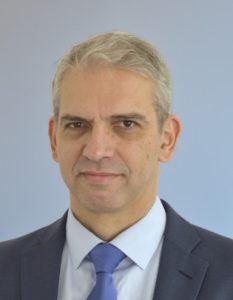
Project Coordinator Professor Nikolaos Papakostas, Associate Professor at the School of Mechanical and Materials Engineering in UCD
The research projects span a wide variety of areas, according to Project Coordinator, Prof Nikolaos Papakostas, an Associate Professor at the School of Mechanical and Materials Engineering. “One of our researchers is looking at how advanced sensors can be used to extend the life of industrial reports. The new generation of robots are more precise and accurate. Using sensors, we might be able to get older robots to achieve the same level of accuracy. That’s a lot cheaper than a new robot. The researcher might be able to come up with new ideas during the course of the project to improve the performance and further extend the life of older robots.”
There is a limit to how much a robot’s life can be extended, of course. Another iCircular3 researcher is looking at how blockchain tools can be used to authenticate assembly and disassembly processes to help optimise the recycling of end-of-life robots.
Electric vehicle batteries are the focus of another project which is looking at how to calculate their remaining useful life with a high degree of accuracy. This will facilitate the use of second-hand EV batteries for electricity grid backup storage. Considering the expense of EV batteries, this could prove very valuable in making the vehicles more affordable.
Supporting the sharing economy
“Our UK partner is looking at circular cyber physical products as a service,” says Ghadimi. “This will support the sharing economy and help companies to adopt rental models for their products. This is quite interesting and can work for single owners or for shared ownership. Another research is looking at reverse logistics for end-of-life power tools. This will help producers to fulfil their responsibility to take back end-of-life products.”
These projects along with the other research being carried out will have broad applicability across numerous sectors. “We will be able to use the output to develop a circular economy framework for these sectors and others,” says Papakostas. “We also hope to inform policy and standards development in the area.”
If you are interested in finding out more about the Horizon Europe programme contact horizonsupport@enterprise-ireland.com for further information or go to www.horizoneurope.ie
Ends