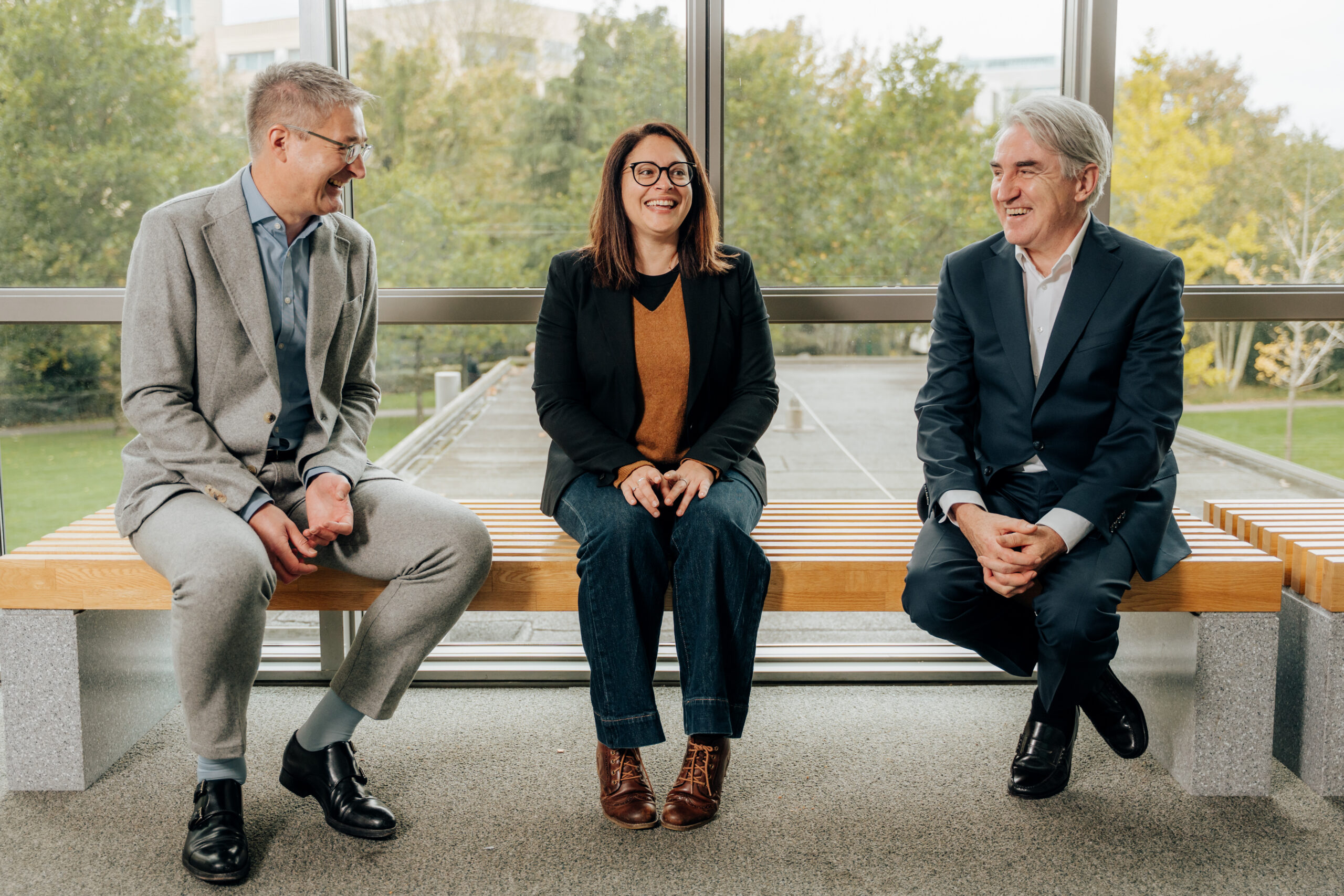
Pictured above L-R: Holger Muller, CEO, Provasctec; Florence Herisson, R&D Group Manager, Provasctec; Noel Caplice, CSO, Provasctec.
A potentially revolutionary treatment for critical limb ischemia is currently being developed by Irish company Provasctec as a partner in an ongoing Eureka-Eurostars project. Eurostars is part of the European Partnership on Innovative SMEs which is co-funded by the European Union through Horizon Europe. The programme supports SME-led collaborative research and development and enabled Provasctec to bring together specialist partners in Switzerland and Sweden to address critical technical challenges on the path to commercialisation. Critical limb ischemia is a progressive disease caused by arteriosclerosis which severely restricts blood flow to the legs and feet and can eventually lead to limb amputations if not treated in time. Standard therapy, angioplasty or by-pass surgery, while effective in coronary artery conditions, is largely ineffective in peripheral vascular interventions due to the specific anatomy and type of disease in peripheral arteries, specifically below the knee.
The Provasctec solution involves the positioning of mesenchymal stem cells (MSCs) at the site of the blockage. These cells release what are known as paracrine factors which stimulates angiogenesis which sees existing arterial cells form a new microvascular network that bypasses the main obstruction improving downstream blood flow. A number of seemingly intractable obstacles had to be overcome in the development of the therapy. The first was the mismatch between the lifespan of MSCs, which is typically two to four days after the injection or infusion in a patient to the time for angiogenesis to establish – typically two to four weeks. The second was the need to get the cells to the disease site in sufficient quantities.
Precisely targeted therapy
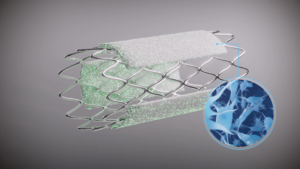
Provasctec’s proprietary local delivery device
The solution developed by Provasctec is to embed the cells in a protective, organoid type environment that prolongs the viability of the cells for months. By designing the shape of the environment to be similar to an intravascular implant, it allows the cells to be positioned precisely at the site of medical need in concentrations thousands of times greater than traditional delivery systems like intramuscular injection or intravenous infusion.
Provasctec’s co-founder Noel Caplice began work on the treatment some 10 years ago while working at the Mayo Clinic in Rochester, New York. “That was at the advent of cell therapy,” says CEO and co-founder Holger Müller. “He noticed that the cells die quite rapidly and invented a new organoid environment and showed in a large animal study that it had exactly the desired effect. The cells produced growth factors which triggered a new arterial system that increased the blood flow and made the heart work better. He used it in the heart and not in the peripheral arteries at the time, but the concept is exactly the same.”
Noel returned to Ireland some years later and founded Provasctec with Holger Müller. “That’s when work kicked off in earnest,” says Holger. The basic principle might sound straightforward, but it is actually extremely complex. “It’s important to understand how MSCs work,” Holger points out. “Some people think they just magically turn into new arteries. That’s not how they work. They work through what’s known as a paracrine mechanism – they tell other cells what to do. And because they are stem cells, they can talk several languages. The language in this case is angiogenesis, but they can also impact inflammation and cell regeneration.”
He explains that an arterial blockage causes a shortage of oxygen which in turn triggers cells to generate new blood vessels. “That is a process that happens in your body every day, thousands of times untriggered. But when you have really blocked arteries, the key is to enable the cells to do that for a prolonged period of time and that is exactly what our solution does.” The Provasctec solution uses MSCs harvested from bone marrow, he continues. “They could also come from a placenta or fatty tissue. We work with bone marrow because we validated in our laboratory at Cork that they generated the highest concentration of the pro-angiogenic growth factors that we were after.” Once harvested they are grown and kept in a culture.
The next step in the process is critically important. Holger explains that the traditional method of treating a patient with stem cells is to inject them into the bloodstream or muscle. “They are put into a completely different environment with different nutrients, pH, and temperature and that leads to cell death. We protect them from that by putting them in our biodegradable organoid membrane which has a defined porosity, so that the cells have enough space to be comfortable, are shielded from the external environment, but can still talk to that environment and communicate with cells. This enables them to live for several months.”
In essence, the membrane is a container which Holger describes as a “mobile home”. “Home, because it protects them from the harsh environment and mobile, because we can position it anywhere in the body,” he explains. “With critical limb ischemia, we park the cellular implant in front of the blockage in the artery, but we are also currently thinking of other applications where a high concentration of cells, localised for a prolonged period of time would be beneficial to a regenerative process.”
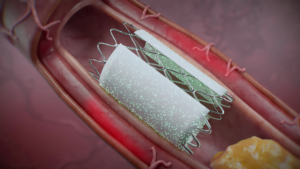
Cellular implant placed in front of the blocked artery.
Extending the therapeutic window
The “mobile home” extends the therapeutic window, he adds. “Typically, MSCs die within two or three days, or at least 90% of them do. They do some good, but to really make a difference for the arteries to grow, it takes two to four weeks. But if you extend their life to several months, you can be sure that the time required for the regenerative process to kick in is covered; that’s our secret sauce.”
The solution has evolved in a number of ways since the company was founded in 2023. Initially, Noel’s early experiments had involved using genetically manipulated smooth muscle cells, but this approach would have created an additional regulatory hurdle for the therapy.
“By that stage, there was a much better understanding of how stem cells work and we moved from genetically modified cells to MSCs,” Holger explains. The next step was to work out how the “mobile home” could be manufactured at scale. “The original one was built by hand so wasn’t scalable. The technology of electro-spinning was ready for prime time in 2023.” Electro-spinning involves melting a polymer and passing it through an electric field to create a non-woven irregular pattern with the molten thread. “You get a randomised structure that you can influence. It can be designed for anything but is for cells in our case.”
The next advance was the delivery mechanism. “This was one of our breakthrough moments,” says Holger. “We separated the design of the ‘mobile home’ from the delivery technology, which is a stent. By separating it, we can now manufacture it much more easily and we can deliver it with established technologies.” This will speed up clinical adoption as deployment will involve the same established process used with other stents.
Eurostars funding
To progress the development of the therapy, Provasctec decided to collaborate with international partners in a Eureka-Eurostars project. The programme is designed to help innovative SMEs lead market-oriented international R&D projects, reducing risk while giving companies access to public funding, specialist expertise, new business relationships, and international markets. For Provasctec, this facilitated access to unique capabilities not available in Ireland. That led to the formation of the nuflo CelTx consortium with Empa of Switzerland contributing electrospinning capabilities with Swedish company Cellcolabs manufacturing the cells. Provasctec as the lead partner leverages its medical and cell biology capabilities to develop a finished product from the individual components.
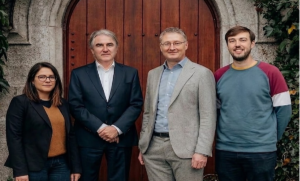
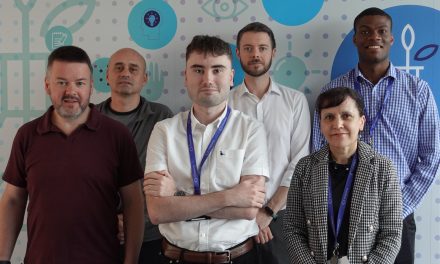
Provasctec team pictured L-R: Florence Herisson, R&D Group Manager; Noel Caplice, CSO; Holger Muller, CEO; Robert Hayes, Technical Scientist
“Our business model is based on having a research team in Ireland and assembling the elements of the product in a similar way that Apple manufactures the iPhone,” says Holger.
“We could not afford to develop these competencies solely in Ireland. Funding for the €2.1 million Eurostars project was made available through national agencies, including Enterprise Ireland, and enabled us to deliver on our ambitions. The project has been extremely successful, and we have now applied for follow-on funding mainly to investigate additional clinical applications for our concept.”
The grant from Enterprise Ireland supported the development of the membrane, selection of materials, and how to spin it, so that the cells would thrive. It also supported the development of a manufacturing process for the cells.
“Here in Ireland, we put everything together and proved that the cells behave the same in the membrane as in the culture and that new arterial growth is observed. We also wanted to prove that if we take the cells in the membrane and freeze them down to liquid nitrogen temperature, and then warm them up, they still work. The answer to that one is also yes. And that is an important element because only when you can freeze and warm them up, can you have a scalable off-the-shelf product. That greatly facilitates logistics, commercial adoption, and much more.”
Next steps
The overall goal is to proceed to reach first-in-human trials in 2028, but a few more regulatory milestones need to be passed before that. “It is classified as an ATMP (Advanced Therapy Medicinal Product). That means before we can move into a human test, we need to prove its efficacy, and safety first.” Efficacy is critically important for investors while safety and toxicology are mandated by regulation. “We need to demonstrate that the cells are maintained in the mobile home and don’t move out of it and that as the mobile home biodegrades over 12 months it doesn’t cause any inflammation or produce large particles that could then cause another blockage of the arteries.” The team will also need to show that all of the MSCs are dead by the time it biodegrades so that they will not cause any unwanted effects elsewhere in the body.
Future plans
In parallel to that work, the company is investigating other potential uses for the therapy. “We do not want to be a one hit wonder. We are looking at modifying our mobile homes to take different shapes to be applicable to different diseases. We think we can be helpful where there’s a need for a high concentration of stem cells at the fixed location.
If you are interested in finding out more about the Eureka programme, please contact Ireland’s Eureka National Project Coordinator, david.flood@enterprise-ireland.com.