
The number of people living with dementia in Ireland is projected to more than double to 150,000 in 2045. In the EU, the number is expected to reach a staggering 14.3 million by 2050. Beyond those statistics lie the complex care needs of people with advanced dementia.
Many of those patients live and die in nursing homes, without receiving the comfort and person-centered care they need. They may experience pain, distress, and loneliness, while families and nursing home staff can struggle to make decisions about treatment and end-of-life care. Traditional approaches can fail to address emotional, social and spiritual needs.
Launched in January 2024, the In-Touch (iNtervention To imprOve comfort, QUality of Life and social engagement of people with advanced dementia in Care Homes) study aims to address these issues by bringing person-centred, non-drug-based palliative care into everyday practice in nursing homes, strengthening connection, compassion, and comfort for people with dementia, their families, and the staff who care for them.

Nicola Cornally, In-Touch Project Coordinator
The €7.5 million Horizon Europe and Innovate UK-funded five-year research project combines two approaches; daily sessions with residents and family care planning meetings. The daily sessions focus on sensory engagement and comfort, inspired by the Namaste Care approach which emphasises sensory-based activities and a calming, compassionate environment. The family meetings are aimed at helping families and care staff make shared, compassionate decisions about current and future care, based on the Family Carer Decision Support (FCDS) tool.
The project has its origins in previous work carried out by project team members, according to Project Coordinator Nicola Cornally. “Many of us are working as health care professionals and have experience of long-term care settings. We identified that some people with advanced dementia in those settings can’t take part in usual activities as the disease progresses,” she explains.
“They may not be able to engage with the staff or with their family and visitors. Things are happening around them rather than with them. This is not nice for them to experience or for the staff and their families to witness.”
Preparing for difficult decisions
The decision support element follows on from a previous project carried out by consortium members in six EU countries and coordinated by Professor Kevin Brazil from Queen’s University Belfast. This was a JPND (The EU Joint Programme – Neurodegenerative Disease Research) project whereby the Irish arm of the project, led by Cornally, was co-funded by the Health Research Board (HRB). This project on person-centred palliative care was known as the mySupport study Palliative Care Research Projects
“We had done a lot of research in the area of advanced care planning and decision making particularly around end of life,” says Cornally. “We’ve worked with staff in nursing homes, supporting them with training and helping them to engage with families on decision making. These could be decisions like whether a resident would be transferred to hospital for acute care intervention at end of life. Family members can be unprepared for those decisions and that can cause anxiety and sometimes conflict with staff and within families.”

Suzanne Timmons, In-Touch Project Co-lead
The Family Carer Decision Support (FCDS) tool is based on this previous work, and helps families to be prepared to make these decisions. “It also helps staff members to have those conversations with families. Our intervention is very much focused on helping families to plan for comfort care and helping staff to provide comfort care to residents.”
Based on extensive research on the type of information families around the world want in relation to advanced dementia, the FCDS tool includes a question-and-answer booklet for families called the Comfort Care Booklet. “There is also a workbook that families can use to help them engage in family meetings with staff in the nursing home.”
It’s about preparing people for advanced dementia and what that looks like, adds Suzanne Timmons, project co-lead. “It’s also about preparing people for their loved one’s end of life. There is a big focus on decisions, but the process within the study helps people think about the future, recognise deterioration in a person and be prepared for the future and what it holds, even though that’s hard for anyone to think about.”
Feedback from nursing homes across Europe and Ireland was very positive in relation to the decision support tool developed in the mySupport project but it was felt that more needed to be done. “While it was planning for comfort care, we didn’t have the element of actually providing a comfort care approach. What are staff supposed to do and how can they do it? So that’s why we combined the two in this project.”
Multi-sensory engagement
Cornally points out that dementia has a very high disease burden. “It impacts so many facets of a person’s life and also impacts greatly on those that care for them. There is cognitive decline and physical decline as well, which is really challenging both for family and staff. Based on the international literature, on our experience, and on our clinical observations, we identified that this cohort, and particularly those in the more advanced stages, require support in order to improve their quality of life towards the end of life. And that connection and reconnection with staff and families needed to be improved.”
The comfort care element of the In-Touch study is the resident sessions involving multi-sensory engagement on a daily basis. “That really brings them back into the fold within the nursing home, so that the activities aren’t happening around them anymore,” Cornally explains. “The activities are happening with them in a really engaged way.”
Grant application support
“A call happened to come out from Horizon Europe at the time in relation to palliative care innovations for non-cancer populations,” says Cornally. “We decided to apply for funding and started to build the consortium from there.” The consortium involves 13 organisations across 10 European countries including Irish partners; the School of Nursing and Midwifery, University College Cork and the Centre for Gerontology and Rehabilitation, University College Cork.
Enterprise Ireland support during the funding application process was very helpful, says Cornally. “We received €12,500 in Horizon Europe Coordinator Support funding from Enterprise Ireland and that allowed us to employ someone to help with the writing and project management of the grant application. That was a huge help as all the team members are working full time and are very busy. We also received support from Irene Castellano, a Horizon Europe National Contact Point for Health, and from Kay Duggan-Walls, her predecessor, both based at the HRB.”
Having been approved for Horizon Europe funding in 2023, the project kicked off in early 2024. The study will test how well the combined approach works for residents, families, and staff across nursing homes in Europe, helping to build stronger evidence for improving dementia care everywhere. It will take place in 56 nursing homes across seven European countries, involving nearly 300 residents. In Ireland, eight nursing homes and about 48 residents will take part. Nursing homes will be randomly assigned to receive the In-Touch intervention or to continue with care-as-usual for 12 months.
Researchers will assess the impact of the programme on residents’ comfort and quality of life, as well as on family satisfaction and staff well-being. The study will also explore how feasible, cost-effective, and sustainable the intervention is over time.
With recruitment of nursing homes concluded and ethics and other approvals in place, the project has now moved into the trial phase. “We’re at the point where we are signing contracts with site nursing homes, doing the staff training, and then we will be starting the actual intervention once we’ve residents and their families recruited. This is an exciting time for our project team”, says Timmons.
Benefits for patients, families and staff
It is hoped that the project will deliver benefits to residents and their families as well as to nursing home staff in both the immediate and longer terms. “We’re hoping to improve the quality of life and comfort of patients enrolled in the trial,” says Cornally. “We’re also hoping that we can improve the knowledge of staff around dementia palliative care.”
Another aspiration is to reduce burnout and increase job satisfaction among nursing home staff. “It can be quite a challenging environment,” Cornally explains. “Staff can have a sense of not being able to provide the care that residents need because they don’t know how to connect or engage meaningfully anymore. We are hoping to address that.”
For families, the aim is to improve their understanding of and preparedness for dementia as it progresses as well as to enhance their communication with nursing home staff to support decision making and help them make meaningful reconnection with their relative.
“In the longer term, we’re hoping that we are going to have an intervention that’s cost effective, that can be scaled across Europe, that supports better palliative care in care homes and gives better access to people for palliative care interventions in care homes,” she adds. “We’re also hoping it demonstrates social innovation around dementia, particularly in the care home setting and that we will have an intervention which can be written into policy and clinical guidance on how to implement it across care homes in Europe.”
There is also a social dimension in terms of increasing awareness around dementia. “This will hopefully lead to increased supports for family members of people with dementia, because this is an area that is often neglected.”
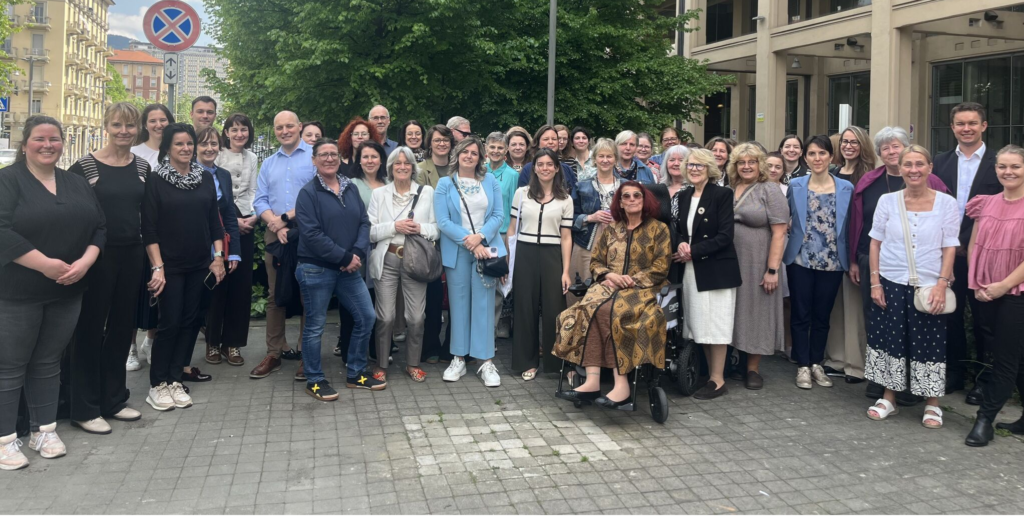
Third General Assembly of the European project In-Touch, held in Turin, Italy, April 2026.
Learn more about the In-Touch project here. For further information about Horizon Europe go to www.horizoneurope.ie