Pollution, habitat degradation and economic activities all pose increasing threats to the health of the world’s oceans, and the Irish element of an EU-funded project has demonstrated how seaweed can make a positive difference. The five-year PHAROS project is pioneering innovative approaches to ocean management and has received €9.49 million in funding from Horizon Europe out of a total budget of €9.97 million. The project involves three lighthouse demonstrations in the Atlantic using nature-based solutions and integrated multi-trophic aquaculture (IMTA), tailored to specific regional needs, to help reverse biodiversity loss, improve ecosystem health, and address the impacts of climate change and human activities. The three demonstrations are located in Gran Canaria in the Canary Islands, Iceland, and Bantry Bay in Ireland and all are taking place under the framework of the Mission to Restore our Ocean and Waters by 2030.
The PHAROS project will also involve stakeholder engagement, education initiatives, and collaboration with other European projects with the overall aim of translating the research into practical, scalable solutions that can be adopted across Europe’s Atlantic and Arctic regions. Led by the Oceanic Platform of the Canary Islands, the PHAROS consortium comprises 25 participating organisations from across Europe including Irish partners Bantry Marine Research Station, Munster Technological University and the International Consortium of Research Staff Associations.
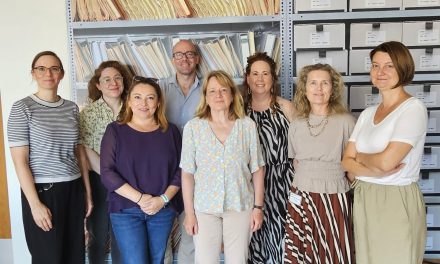
Julie Maguire, Research Director of Bantry Marine Research Station.
Reducing salmon farming waste
The Bantry Bay demonstration (Demo 3) combines salmon farming with macroalgae (seaweed) cultivation to reduce nutrient waste and enhance biodiversity, explains Demo Leader Julie Maguire of Bantry Marine Research Station.
“We are carrying out integrated multi-trophic aquaculture (IMTA), which means growing seaweed beside a salmon farm,” she adds. “Cultivating seaweed beside salmon is great because seaweed loves CO2, it loves nutrients and sucks up everything from the salmon farm – the waste from the salmon themselves, uneaten food, and other nutrients. Seaweed also loves ammonia.”
A win-win-win outcome
In very simple terms, the demonstration aims to use seaweed as a cleanup agent for the waste and other byproducts produced by the salmon farm. “It’s great for the seaweed, it’s great for the salmon and it’s great for the ocean environment.”
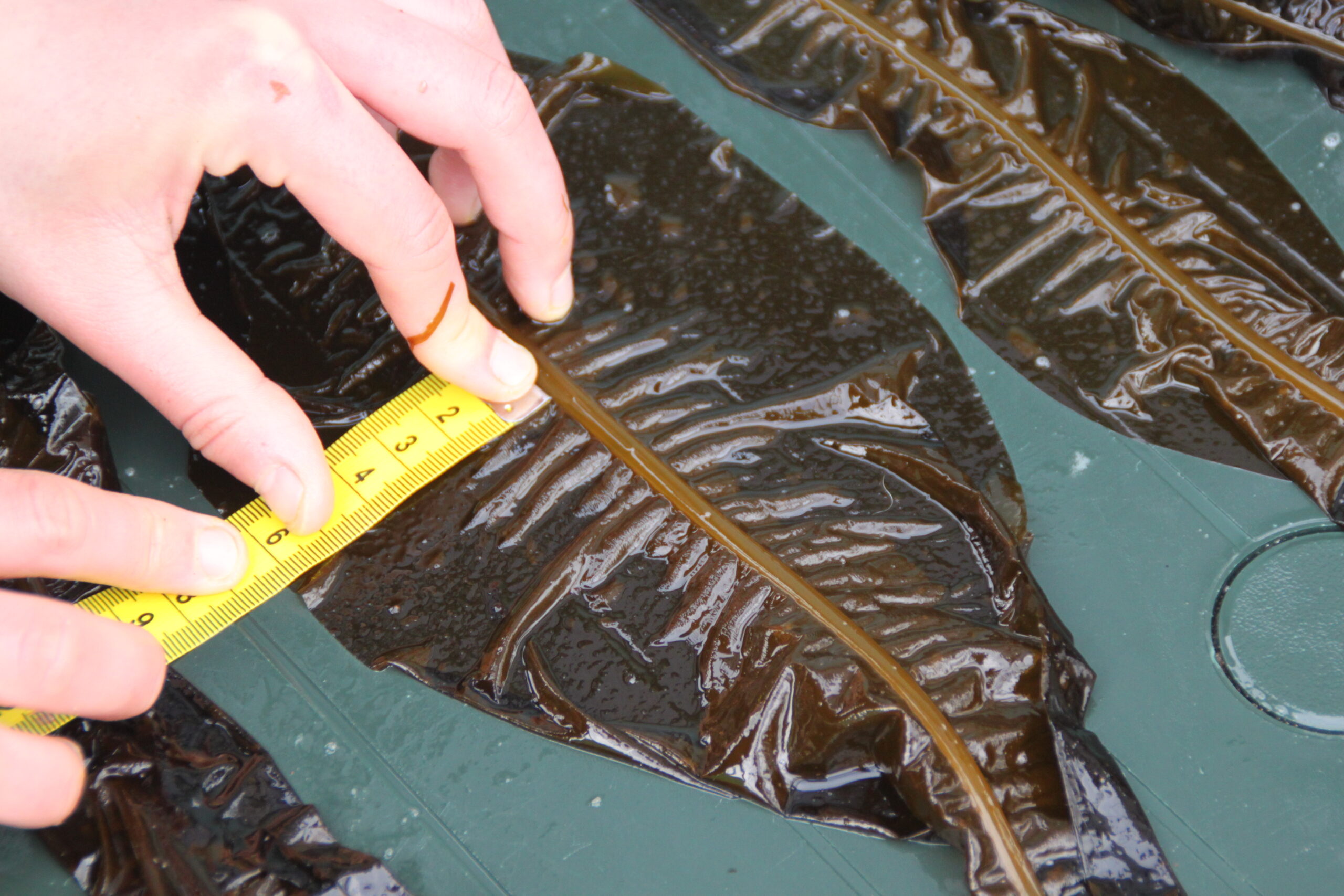
The seaweed, in this case kelp, is seeded each year between October and November and allowed to grow until the following summer. The plants are seeded on string which is placed around ropes which are laid in the water and are microscopic in size at the outset. Growth is slow at the outset and begins to accelerate in early spring, according to Maguire. “It starts to grow really fast in February, March and April. In March of this year, it was around four kilos per meter and it increased to 17 kilos in one month. That is some daily growth rate.”
Once spores start to appear on the plants in summer, that is the signal to harvest and begin the process all over again in the autumn.
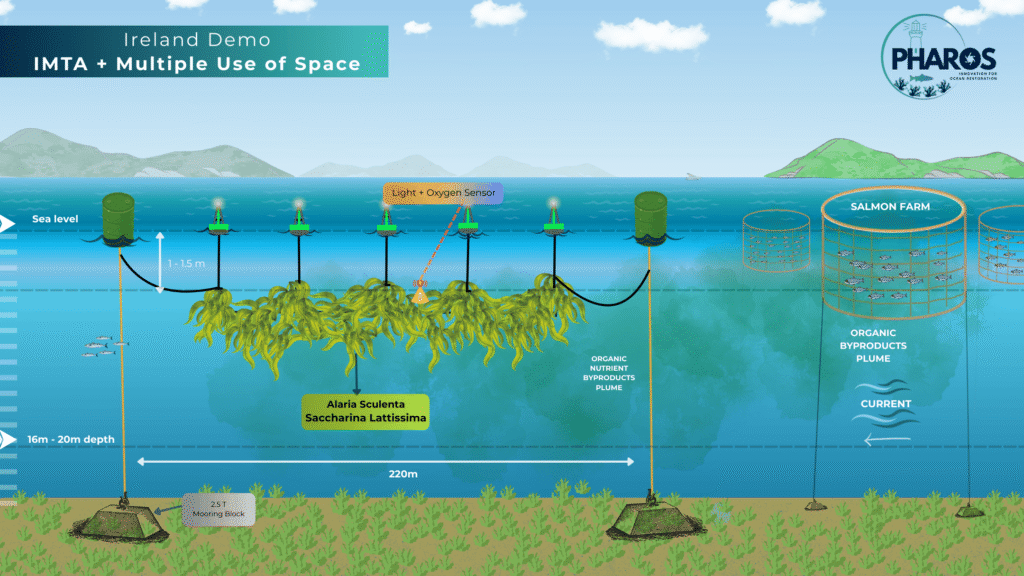
Demonstration site of Irish salmon farm and macroalgae combination.
Promoting biodiversity
The project was approved for funding in 2024 with the Demo in Bantry Bay commencing later that year in time for the 2025 season. The results so far have been very encouraging. “Kelp is a fast grower, a super absorber and a great carbon scrubber,” says Maguire. “Not only does it clean the water, the kelp promotes biodiversity as well. We took samples of all the little creatures, all the organisms that live around the seaweed to see if there was a difference between the Bantry Bay site and a control site in Roaringwater Bay where there is no fish farm. There was a huge difference. We found that Bantry Bay site was much more biodiverse than the control site. We found organisms actively crawling along the ropes and the buoys and the seaweed, but not eating it, they are just living in what is a nice habitat for them. There was also good news for the salmon farmers as the seaweed didn’t harbour any of the kind of the organisms that could be harmful to the fish.”
The first year produced an anomalous result in terms of the seaweed growth in the two sites. Growth in the control site actually outstripped Bantry Bay. “We are not quite sure what happened,” says Maguire. “The nutrients were very plentiful in Roaringwater Bay, and the seaweed grew very well that year.” However, that situation has reversed in the current year with the Bantry Bay kelp comfortably outgrowing its Roaringwater Bay counterpart.
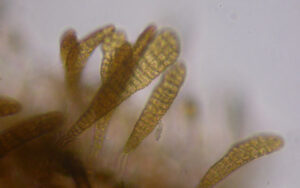
Microscopic Alaria plantlets.
Very importantly, it has been proven that the Bantry Bay seaweed is drawing nutrients directly from the salmon farm. “We did some stable isotope analysis on the nitrogen because we weren’t sure where the seaweed was getting it from. Was it coming from the salmon farm or other places? And it turned out that 93% of the nitrogen came directly from the salmon farm.”
A further question arises in terms of uses for the seaweed post-harvest. “We normally get it dried because seaweed, when it’s harvested, doesn’t last very long. You’ve got about 48 hours to do something with it, and then it starts to rot. That’s a pity, because we put all this effort into capturing these nutrients, soaking up all the CO2 and greenhouse gas emissions, and then you have to use a lot of energy to dry it. We have made silage out of it as well, which is great because it doesn’t require any drying step. It’s a tricky enough fermentation process, but it’s doable. Animal feed is a big usage, especially for horses.”
Salmon is another potential usage. “We looked at salmon feed because it’s the main fish species that we grow in this part of the world. The fish feed companies spend an awful lot of money on R&D, and the feed conversion ratio is very good. It’s almost one to one. If you feed a fish a kilo of food, it will grow by almost a kilo, it’s almost at that level. We did a trial with our own feed. We replaced the protein with the seaweed protein, and it grew at the same rate. A lot of fish feed is made from soy protein, which is imported from South America and other places around the world. We have so much seaweed in Ireland that could replace that.”
There is also demand from the cosmetics industry, she notes. Unfortunately, it has very limited value as a fertilizer as it quite expensive to produce in comparison to current commercial fertilizer prices.
Symbiotic cleanup solution
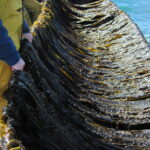
Alaria esculenta grown in Bantry Bay adjacent to a salmon farm.
However, a compelling case has been made for IMTA as a symbiotic cleanup solution for fish farms. “It’s a scalable solution,” says Maguire. “There is no reason why you couldn’t have a seaweed site beside every salmon farm in the country, or elsewhere, because it soaks up all the nutrients. We even calculated how much seaweed you would need to grow to negate the salmon farm completely. It was something around in the region of nine to one – for every tonne of salmon, nine tonnes of seaweed would work.”
It doesn’t necessarily have to be fish farms. “You can put the kelp beside any place that’s eutrophic. Even if you put a seaweed farm in some really polluted area, there are other things you can do with it, you can make bioplastic or biodiesel, for example. It’s very good at soaking up metals as well. Arsenic in particular, lead, cadmium, it’ll soak up anything that’s organic that even has metals attached to it. It’s great for bioremediation. And it’s pretty simple to grow.”
Participation in the Horizon Europe project has benefitted Bantry Marine Research Station as well. “We have learned a lot from our partners most of whom have different skillsets,” says Maguire. “For example, modelling the production cycle has been very insightful.”
Looking ahead to the next three years of the project, she says: “The Demo in Bantry Bay has demonstrated that placing kelp cultivation alongside salmon cages significantly enhances marine biodiversity, supporting the PHAROS objective of ecosystem restoration through nature-based solutions. It will be interesting to see what results we get in the next three production cycles.”
If you are interested in finding out more about the Horizon Europe programme, contact horizonsupport@enterprise-ireland.com for further information or go to www.horizoneurope.ie