The recent controversy relating to the proposed introduction of a digital national identity card in the UK has served to highlight the importance of the EU COST (European Cooperation in Science and Technology) funded History of Identity Documentation in European Nations (HIDDEN) project.

Dr Jennifer Redmond, Associate Professor of History at Maynooth University
Led by Dr Jennifer Redmond of the Department of History at Maynooth University, the €783,000 project looks at the history of ID regimes in Europe and beyond, drawing connections between the past and present. Along with dozens of network members drawn from universities across Europe, the other Irish partners are University College Cork, Mary Immaculate College/UL, University College Dublin, and Galway University.
“Identity documentation has come to feature in every part of modern life,” explains Dr Redmond. “It is often linked to migration, a global challenge shaped by crises of climate, economics, pandemics, politics and war. Documents available to citizens fleeing crises are determined by place of birth, geopolitics, gender and colonial and family legacies. HIDDEN analyses how states hinder or help citizens accessing ID, the role technology plays and what ethics are involved in accessing past personal data.”
Promoting dialogue and influencing policy
The project explores issues of identity, citizenship and migration by connecting historical research on identity documents with modern, digital forms of identity documentation and the laws that create and determine them. The aim is to create academic and public-facing events to enhance public dialogue around ID and inform future policy decisions.
She points to the importance of ID in different circumstances. “The most important category of people that need identity documentation and don’t have it are stateless people or people who have been rendered stateless not by migration but through the policies of their own governments and regimes,” she notes. “The Rohingya are a classic example of that.”
She also points to the Windrush scandal in the UK. “People who had been in the UK for over 50 years were suddenly asked to prove their right to remain in the country. How do you do that? Some of the documents that they were being asked for either never existed or were actually handed over by them to the authorities upon entry into the country, and should have been archived, but an ordinary person doesn’t know where they are or how to go about finding them.”
A timely project
It is little surprise therefore that UN Sustainable Development Goal 16.9 states that everyone should have a legal identity by 2030. “In the context of the rise of new forms of biometric digital ID it is timely that an interdisciplinary and multidisciplinary group of scholars critically examine the antecedents of modern systems and contemporary practices which can increase societal inequalities,” Redmond points out.
 The project has its origins in an Irish Research Council (now Research Ireland) funded postdoctoral project carried out by Redmond. It looked at the introduction of identity documentation for travel between Britain and Ireland during the Second World War.
“Up to that point, people had never shown any ID and never possessed any ID, they just went over and back,” she notes. “But the war meant more regulation. This was a very unusual experience for people. A lot of people objected strongly; they were quite suspicious of the government collecting this information on them.”
That led her to the concept of the HIDDEN project. “I wanted to explore where we are going in the context of biometrics and AI and the tension between the EU desire to have freedom of movement but also having national security concerns in mind,” she says. “I wanted to try and figure out a way to learn more from different people who worked on different aspects of this. I wanted to know about different nationalities and their experiences, so I decided to go for this COST Action.”
Support for professional assistance and guidance
The next step was to approach Enterprise Ireland for assistance. “Enterprise Ireland was key because they gave me money to access a professional grant writer. Although I had the idea and I knew what I was talking about, I didn’t know how to frame it properly in a grant application form. I don’t think I could have done that without the grant writer and I couldn’t have got the grant writer without Enterprise Ireland. I’m really thankful for that assistance.”
She also engaged with the COST National Coordinator who gave helpful feedback on the idea and explained more about how the funding worked. “I also did some training that answered some of the technical questions about how many partners you need to have and so on.”
Having assembled the network, the four-year project commenced in 2022. Network members bring knowledge, information and experiences of ID in their countries both historically and in the present day.
Filling a gap in policy discussions
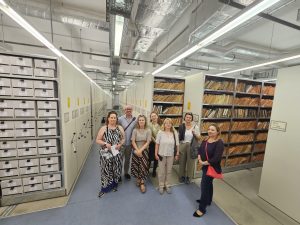
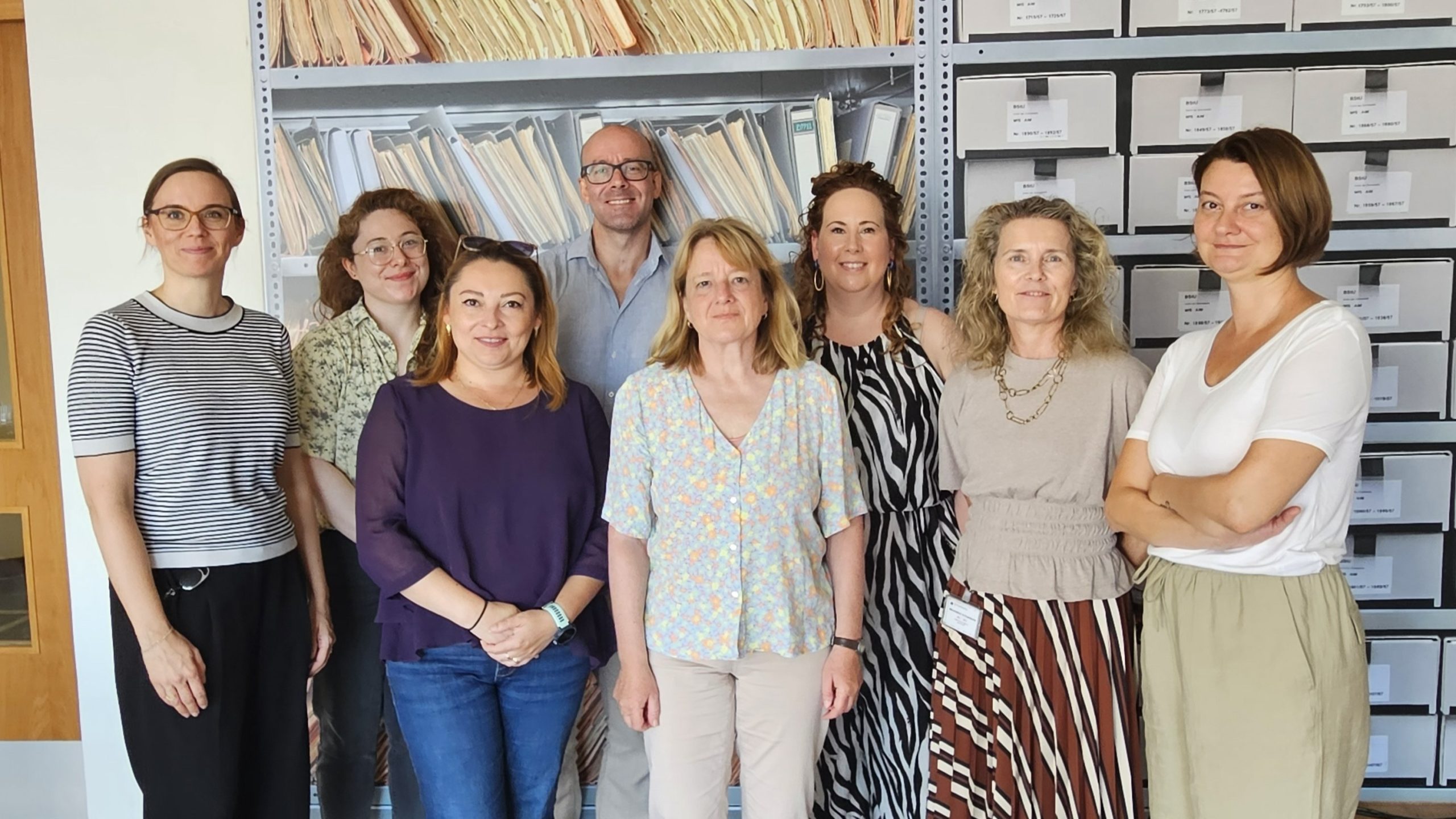
HIDDEN members inside the Stasi Archives, Berlin, August 2025
“We’ve been trying to engage with NGOs, policy makers, activists, people with lived experience of statelessness, of migrancy and of being refugees,” she says. “When you’re in migration studies, it’s very common that you yourself have been a migrant at some point. We have people in the network that have lived experience of being a refugee, of being stateless, of being a migrant, and sometimes what’s missing in current policies is that personal experience and perspective. One of the things that I wanted to do was have events where these people are all in the room with each other.”
But it’s not just academics talking to each other, and it’s not just academics talking to activists, it’s trying to triangulate that by having policymakers in the conversation as well, she explains. “It’s not anything revolutionary either, it’s more in the realm of nudge culture. Something that maybe tips the balance by having that perspective. We have had people from the European Commission at our events and they are the ones thinking about things like a European identity card.”
Addressing potential risks
Among the main outputs from the project will be scholarly publications that can be used in teaching and research. “Many of our publications will be open access so anybody can use them,” she says. “We’re also going to produce a handbook on the ‘Past, Present and Future of Identity’ which covers a very long chronological span of how these kinds of documents come about in different countries, and where they are going with them. There’s a huge amount going on now in terms of biometrics and AI to strengthen borders. But some of that is in flux. The new EU Pact on Asylum and Migration is almost a year and a half old and it has not yet been completely worked out how the new rules will operate, although we do know that it’s stricter and they want shorter processing times for assessing asylum claims.”
This may bring about new risks including for those refugees and asylum seekers who for one reason or another do not have identity documentation and the only way they can get it is by returning to the country where they have been persecuted.
“How do you fix this?” she asks. “Making technology the arbiter of things is risky and we know that the technology can have biases, so it is not as impartial as we might want it to be.”
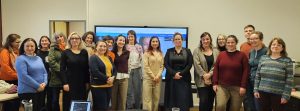
HIDDEN members at the International Social Service Secretariat archives, Geneva, Jan 2024
A sound legacy
The aim is also to send some of the final outputs to policy makers. “We will keep including them in our events to get them to think about these things and we will also do more traditional scholarly activity as well. We’re thinking about applying for a Horizon Europe Marie Skłodowska-Curie doctoral training network grant because a big emphasis of the project has been to train a new generation of scholars. We’ve done a lot of training and professional development with them and that will be part of the legacy of the project.”
The final event will take place in the National Gallery of Ireland over four days in 2026 which will bring the project outputs into the public realm.
 To learn more about COST actions go to http://www.COST.eu If you are considering an application to COST or would like to join a current Action or would like information on any aspect of the programme, please contact David Flood, Ireland’s COST National Coordinator (CNC), at David.flood@enterprise-ireland.com
If you are interested in finding out more about the Horizon Europe programme contact horizonsupport@enterprise-ireland.com for further information or go to www.horizoneurope.ie