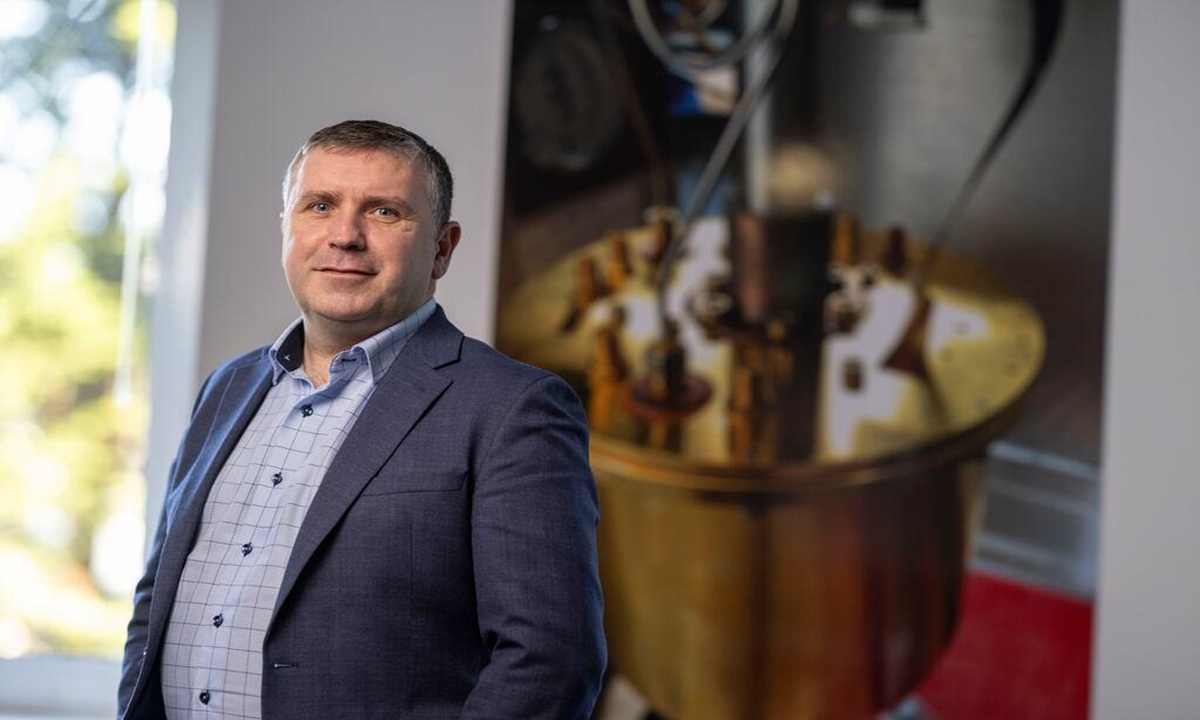
Pictured above: Jason Lynch, CEO Equal1.
Quantum computing has the potential to solve some of the world’s most pressing problems and Irish deep tech company Equal1 is at the forefront of its development. Supported by a €2.5 million grant from the European Innovation Council (EIC) Accelerator under Horizon Europe, alongside additional private funding, Equal1 has become one of the first companies in the world to commercially deploy a rack-mounted quantum computer in a standard data centre environment.
The EIC Accelerator-supported QUENML project enabled Equal1 to design, fabricate and validate successive generations of its UnityQ Quantum System-on-Chip (QSoC) technology. The result is the Equal1 RacQ — a rack-mounted quantum computer that is already in operation at the European Space Agency.
In essence, Equal1 has developed a quantum computer that fits in a standard data centre rack. This is fundamentally different from existing quantum computers, which tend to be large, fragile laboratory installations that require room-filling refrigerators, specialist facilities, and power infrastructure separate from conventional data centres. Scaling them to the size needed to achieve genuine advantage over existing classical computer systems is considered extraordinarily difficult. Instead, the Equal1 RacQ quantum computer plugs into a standard power socket and costs significantly less than those other systems.
Significant breakthrough

Martin Farnan, Programme Manager at Equal1
The importance of this breakthrough is difficult to overstate. Quantum computers will be able to perform complex calculations that are impossible for classical computers. By making the technology more accessible, a world of possibilities opens up.
According to Equal1 Programme Manager Martin Farnan, quantum computing promises to solve problems that are fundamentally intractable for classical computers – from modelling complex molecular interactions for drug discovery to optimising logistics networks and enabling breakthrough climate technologies.
“Existing computers have limits,” he explains. “Today, if you want to develop a new material, you typically have to do it through trial and error physically in a lab, which can take years or even decades. Quantum computing could change that by allowing us to simulate materials on a computer, promising to fundamentally transform materials science and innovation.”
Another application he points to is nitrogen fixation, a process that is key to manufacturing ammonia for fertilisers. He points out that the Haber-Bosch industrial nitrogen fixation process has transformed agricultural production, enabling the world’s population to grow to today’s 8.3 billion. However, the process consumes roughly 1–2% of global energy supply because it relies heavily on natural gas as the energy source.
On the other hand, nature works with bacteria to fix nitrogen and produce ammonia in a process that requires almost no energy. “If we can figure out how the molecule behind this process works, we could help address global food insecurity,” he says. “But the problem is beyond the capacity of classical computing to solve.”
Solving new problems with established semiconductor technologies
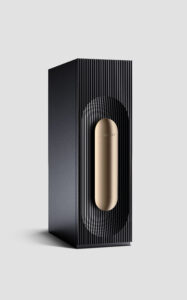
RacQ, rack-mounted, silicon-spin quantum computer developed by Equal1.
He describes developing RacQ as a multi-dimensional problem. “We need to make it efficient enough and small enough to fit inside a rack in an existing data centre. That makes the problem a lot harder than what other companies are trying to do. If you don’t care about the computer’s size, energy consumption, or the cost to build and operate it, designing a quantum computer is a little easier but far less practical to deploy. We decided to rely on the 60-year history of semiconductor manufacturing and use that technology to make qubit chips.”
A qubit chip is a specialised microchip that uses quantum bits (qubits) instead of traditional bits. A qubit is the basic unit of information in quantum computing. Unlike a classical bit, which can represent either 0 or 1, a qubit can exist in both states at the same time through a property known as superposition.
Working with industry partners, Equal1 has manufactured silicon and silicon-germanium qubit chips using similar commercial processes used for every chip in today’s data centres. This approach is widely considered the Holy Grail of quantum computing.
The next problem was the extraordinarily low temperatures these chips require to run, near absolute zero, or minus 273 degrees Celsius (zero Kelvin). Developing a cooling system that could reach those temperatures and fit in a relatively tiny box was challenging. By combining components used in the medical and space industries, Equal1 achieved the required form factor and operates its quantum devices at 4 and 0.3 Kelvin.
Pathway to solving intractable problems
The result is the six-qubit RacQ quantum computer, which is currently operational. “It’s not a very big machine, but it is scalable; that’s our selling point. By getting six qubits working, we can then focus on scaling. Our next generation will have 49 qubits, followed by 512 qubits and, in the future, hope to reach millions of qubits to solve those currently intractable problems.”
The QUENML project ran from June 2022 to March 2025, and EIC Accelerator funding was crucial to its success. “It is a key funding instrument in Europe and one of the very few globally that combines grant funding with direct equity investment for breakthrough deep-tech companies,” Farnan explains.
“Developing a quantum computer in silicon requires sustained, patient capital across multiple chip design cycles, each taking months and costing hundreds of thousands of euros, with no guarantee of immediate commercial returns. The €2.5 million EIC Accelerator grant provided critical funding to support this complex development process and advance Equal1’s technology toward commercialisation.”
Commercial validation
Grant funding was only part of the story. The EIC Equity instrument, which invested €7.5 million alongside the grant, provided critical third-party validation of Equal1’s commercial roadmap and ultimately helped the company close its most recent €60 million funding round. The EIC programme’s structure and network also opened doors to strategic relationships, including with ESA, that would otherwise have been far harder to establish, according to Farnan.
“We also received Disruptive Technology Innovation Fund (DTIF) support which was used to develop earlier versions of the quantum bit chips,” Farnan notes. “The knowledge gained from this prior project was integrated into our EIC project proposal.”
Today, Equal1 operates across six countries – Ireland, the Netherlands, USA, Canada, Romania and Japan – with active customer engagement in the pharmaceutical, finance, materials science, and high-performance computing sectors.
The company is also featured prominently in Ireland’s Quantum 2030 National Quantum Technologies Strategy, recognising Equal1 as a cornerstone of Ireland’s national quantum ecosystem. In addition, the QUENML project’s work directly supports the EU Quantum Flagship’s strategic goals, enabling Equal1 to participate in the Quantum Industry Consortium (QuIC) and engage at European quantum policy events.
“For an Irish company with a world-changing ambition, Horizon Europe provided not just funding but the runway, the network, and the mandate to take quantum computing from a laboratory concept to a shipping product,” Farnan concludes.
Learn more about QUENML project here. For further information about Horizon Europe go to www.horizoneurope.ie.